Thirty-six hours in London sounds like not very much.
It is, in fact, enough. If you spend it correctly. London is one of those cities that rewards a particular kind of attention: not the frantic dash between landmarks, but the unhurried walk that turns a corner and discovers something you did not plan for. This guide aims to give you a framework tight enough to make the most of your time and loose enough to let London do what London does.
This itinerary covers approximately thirty-six hours, from a Friday evening arrival through to a Sunday afternoon departure, and can be adapted to any two-day window.
Evening One: Arrive, Orient, Eat Well
Arrive and Drop Your Bags
London is a city that rewards staying central. If you have the choice, a hotel or flat in the South Bank, the West End, or the City gives you immediate access to the best of what the first evening offers without a long Tube journey at the end of the day.
Drop your bags. Walk outside.
Whatever direction you turn in central London, you will find something worth looking at within minutes. That quality of a city dense enough that the first impression is always good, is the first thing about London to understand.
Evening Walk: South Bank to Tower Bridge
When: Late afternoon into evening
If you arrive with two or three hours of daylight left, the South Bank is the finest introductory walk London offers.
Begin at the National Theatre on the South Bank. Even if you are not seeing a show, the building’s interior bookshop and bar are both excellent. After that, make sure to walk east along the Thames. The view across the river to St Paul’s Cathedral and the City skyline evolves as you move, each bend in the path revealing a new composition of water, bridge, and buildings. Tate Modern, the Globe Theatre, Borough Market (if the timing is right), Southwark Cathedral, and finally Tower Bridge mark the route.
Tower Bridge at dusk, with the Thames lit below it, is one of the great urban views in Europe. It is not diminished by familiarity. Stand on the bridge and look west as the light fades.

Credit: Ziyou Zhang
Dinner: Borough Market Area
The neighbourhood around Borough Market with Bermondsey Street, London Bridge, and the railway arches of Maltby Street has become one of London’s finest concentrated areas for dinner. Pizarro on Bermondsey Street is excellent for Spanish cooking; Brat on Redchurch Street in Shoreditch is worth the Tube journey for its Basque-influenced wood-fired cooking; and the restaurants in the arches around London Bridge offer everything from Italian to Japanese.
For a more casual first evening, Borough Market’s surrounding restaurants and the pubs on Stoney Street serve wine and food at outdoor tables that suit the first-night mood of a city well.
Book ahead for dinner wherever possible. London’s best restaurants fill quickly at weekends.

Credit: Bruno Martins
Day One: The Essentials Done Right
Morning: Westminster and the Parks
When: Start by 9 am
Westminster is the London that everyone knows, and it deserves its reputation. Westminster Abbey, the Houses of Parliament, Big Ben, St James’s Park, Buckingham Palace, and the Mall are all within walking distance of each other. This makes it the best possible introduction to London’s civic and royal character.
Begin at Westminster Abbey. It’s one of the most historically significant buildings in Britain, where monarchs have been crowned since 1066 and where Chaucer, Darwin, Newton, Churchill, and many others are buried or commemorated. Allow ninety minutes; it is easy to rush and deeply rewarding to slow down.
Walk along the Victoria Embankment with views of the Thames and cross Westminster Bridge to the South Bank, or continue through St James’s Park. It’s London’s most beautiful royal park, with the ducks on the lake and the view toward Buckingham Palace across the water, toward the Mall. The walk from Westminster Abbey through St James’s Park to Buckingham Palace takes twenty minutes at a comfortable pace and is one of the finest urban walks in Europe.
The Changing of the Guard at Buckingham Palace operates on most days (check the schedule online for current dates and timing). It draws large crowds; positioning early and toward the side of the forecourt gives a better view.

Credit: Cameron Mourot
Mid-Morning: Trafalgar Square and the National Gallery
When: Late morning
Trafalgar Square is London’s civic centre and the National Gallery on its northern edge is one of the world’s great art museums, with free entry and a collection that spans Leonardo, Vermeer, Rembrandt, Van Gogh, and Turner in rooms that are rarely crowded in the morning hours.
You do not need to see all of it. Choose two or three rooms and spend a proper time in them. The Impressionist gallery. The Vermeer room. The Turner wing. An hour in the National Gallery with genuine attention is worth more than a cursory walk through all forty-six rooms.
Trafalgar Square itself with its Nelson’s Column, its fountains, its views toward Westminster along Whitehall is worth a circuit before moving on.

Credit: Tânia Mousinho
Lunch: Covent Garden or Soho
When: Midday to 1 pm
Covent Garden and Soho sit ten minutes’ walk from Trafalgar Square and offer London’s greatest concentration of restaurant choice within a small area. Covent Garden’s covered market piazza has a touristy character, but the surrounding streets like Seven Dials, Monmouth Street, or Neal Street are home to genuinely good independent restaurants. In Soho, the streets around Carnaby, Brewer, and Dean Street offer some of the finest casual dining in London.
Barrafina in Covent Garden has no reservations and usually a queue, but the tapas are among the finest in London. Kiln on Brewer Street in Soho serves Thai street food cooked over an open flame that is one of the most exciting lunches available in the city.

Credit: Tom Podmore
Afternoon: The British Museum and Bloomsbury
When: 2 pm to 5 pm
The British Museum in Bloomsbury is one of the most extraordinary buildings and collections in the world, and it is free. The Great Court, with its stunning glass-and-steel roof designed by Norman Foster, is itself worth entering. The Egyptian galleries, the Elgin Marbles, the Sutton Hoo helmet, the Rosetta Stone, and the Lewis Chessmen are the things most worth seeing if time is limited.
Two hours in the British Museum is a good visit; three hours begins to approach justice. The café in the Great Court is serviceable; the streets of Bloomsbury, with their Georgian squares, independent bookshops, and the nearby Bedford Square, are worth walking after leaving.

Credit: Christian Lendl
Late Afternoon: A Neighbourhood Walk
When: 5 pm to 7 pm
This is the moment to leave the landmarks and find a neighbourhood.
Shoreditch and Brick Lane, reachable in twenty minutes by Tube, offer east London’s creative energy at its most concentrated: galleries, vintage shops, street food, and the particular quality of a city working through what it wants to be. Alternatively: Notting Hill and Portobello Road for independent London at its most photogenic, with the market (on Saturday mornings) as the best version; Primrose Hill for the finest view in London from a park; or a walk along the Regent’s Canal from Camden to Islington.
Any of these provides the encounter with a London that belongs to its residents rather than its visitors. It’s the encounter that makes a short trip feel less like a tour and more like a beginning of understanding.
Dinner: The City or Shoreditch
London’s dinner options are, to say the least, broad. A few frameworks:
For the South Bank stay: OMA above Borough Market (Michelin-starred, Greek-inspired, excellent) or one of the growing number of excellent restaurants in the Bermondsey arches.
For the West End: Barrafina, Kiln, or for a more complete evening, Brat in Shoreditch.
For something memorable and specific to London: St. JOHN in Clerkenwell – Britain’s most celebrated champion of nose-to-tail cooking, with a Michelin star, a wine list of exceptional quality, and a room that has shaped how British food is talked about for thirty years.
Booking is essential for all of these. London restaurants at weekends are booked weeks ahead.
Evening: A Drink with a View
London’s rooftop bars, riverside pubs, and hidden cocktail rooms all compete for the title of the best post-dinner drink. A few of the strongest options:
Sky Garden at 20 Fenchurch Street has a free admission to the bar (just book in advance) and provides the most complete 360-degree view of London available without a ticket to an observation deck. The south-facing outlook at sunset is among London’s finest visual experiences.
The riverside pubs of Bankside and the South Bank include the Anchor Bankside, the Founders Arms, the Barge House and more. They provide a different version of the same pleasure: a pint outside in summer light, or inside in winter warmth, with the Thames and the City beyond the window.

Credit: Hanlin Sun
Day Two: Going Deeper
Morning: The Tate Modern and the Millennium Bridge
When: 9 am to 11 am
The Tate Modern in the Turbine Hall is the most architecturally dramatic art space in London. It’s a former Bankside power station whose central hall has hosted some of the most memorable contemporary art installations in the world. The permanent collection is free; the seasonal Turbine Hall commission is almost always worth seeing.
Walk across the Millennium Bridge toward St Paul’s Cathedral and on the pedestrian bridge across the Thames that provides one of the most photographed views in the city. Don’t rush, take your time on the crossing.

Credit: James Genchi
Mid-Morning: St Paul’s Cathedral
When: 11 am
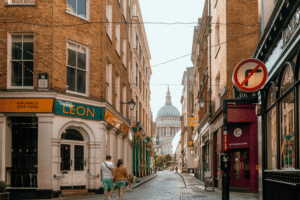
St Paul’s Cathedral is one of London’s greatest buildings and Sir Christopher Wren’s masterpiece. It’s a cathedral built in the aftermath of the Great Fire of 1666, completed in 1710, and still the defining feature of the City of London’s skyline. The Whispering Gallery, the Stone Gallery, and the Golden Gallery provide progressively more spectacular views as you climb. The Golden Gallery at the top of the dome offers the finest panoramic view of London available at this height.
Allow ninety minutes for a thorough visit, including the dome climb.

Credit: Tomasz Zielonka
Lunch: The City or East London
The streets around St Paul’s such as Cheapside, the lanes of the Square Mile, and Leadenhall Market provide excellent lunch options in the City’s concentrated food culture. Padella near London Bridge is one of the finest value pasta restaurants in London; St John Bread and Wine in Spitalfields is the lighter, bakery-focused sibling of the Clerkenwell original.
Afternoon: Choose Your London
The final afternoon of a thirty-six-hour visit is the moment to follow your own instinct rather than the itinerary.
For art and culture: The Victoria and Albert Museum in South Kensington is the world’s greatest museum of decorative arts, free entry, with collections that span fashion, furniture, metalwork, ceramics, and design from every period and culture. Allow two hours minimum.
For royalty and history: Kensington Palace and the gardens of Hyde Park, followed by a walk along the Serpentine.
For contemporary London: A final walk through Shoreditch or a market. The Columbia Road Flower Market on Sunday mornings is one of the most vivid and most specifically London experiences available in the city.
For a quiet last hour choose Hampstead Heath, Primrose Hill, or a walk along the Regent’s Canal that provide the specific pleasure of London’s green and water spaces.
Practical Notes
Getting around: The London Underground (the Tube) is the fastest way to move between areas. A contactless bank card or Apple Pay taps in and out on all London public transport; the daily cap means you never pay more than the equivalent of a day travel card, regardless of how many journeys you make.
Walking: London’s central areas are far more walkable than the Tube map suggests. The South Bank, Westminster, Soho, Covent Garden, and the City are all within 20 to 30 minutes’ walk of each other. Walking between them, rather than taking the Tube for every movement, reveals the city more fully.
Museums are free. The British Museum, the National Gallery, the National Portrait Gallery, Tate Modern, the Victoria and Albert Museum, the Natural History Museum, and the Science Museum are all free to enter. This is one of the most remarkable facts about London, and one of the best reasons to use the free time between paid activities to step into a gallery rather than a shop.
Book restaurants in advance. London’s best restaurants book out quickly at weekends. Planning dinner before you leave home is not excessive; it is simply practical.
Conclusion
Thirty-six hours in London is enough to understand what the city is and to feel the beginning of wanting to know it better.
The South Bank at dusk, the British Museum in the morning, a lunch in Soho, a neighbourhood that belongs to its residents, a dinner that deserves its reputation, a drink somewhere high with the city below you. These are the elements of a very good thirty-six hours in one of the world’s great places.
Come back soon.
To experience London’s finest neighbourhoods, culture, and dining as part of a curated private visit to the city, discover our private London tours.
FAQ
What should I do with 48 hours in London?
With 48 hours in London, focus on landmarks like the Tower of London, Buckingham Palace, Westminster, and the London Eye. Add a Thames river walk, Borough Market for food, and a West End show for a complete short-trip experience.
Is 3 days in London worth it?
Yes, 3 days in London is absolutely worth it. It allows time to see major attractions, explore museums like the British Museum, enjoy neighbourhoods such as Soho and Notting Hill, and experience the city’s food and culture.
Where to go in London for 3 hours?
In just 3 hours in London, visit Westminster (Big Ben and Parliament), walk along the Thames, or explore Covent Garden. These central areas are close together and give a quick but iconic London experience.
What are 7 places to visit in London for free?
Top free places in London include the British Museum, National Gallery, Hyde Park, St James’s Park, Tate Modern, Borough Market (entry), and the Natural History Museum. These offer world-class culture without an entry fee.