Four days in London is enough to understand what the city is.
Not to see everything as London rewards multiple visits across a lifetime but to understand its scale, its diversity, its remarkable density of excellent things, and the specific quality of a city that has been accumulating culture, history, food, and contradiction for two thousand years without any apparent intention of stopping.
This itinerary is built to use four days well. It covers the essential London: Westminster, the South Bank, the British Museum, the East End, the parks and markets, while leaving enough room for the unexpected turns that make a city visit feel genuinely personal rather than programmatic.
The structure changes day by day. Each day has a theme and a neighbourhood. Restaurants and bars are suggested but not prescribed. London’s range is too broad to be definitive about where to eat, and the city rewards following your nose as much as following a list.
Day One: The Historic City
Morning – Westminster and the Parks
Begin at Westminster.
The concentration of historically significant buildings within walking distance of each other such as Westminster Abbey, the Houses of Parliament, Buckingham Palace, or St James’s Park is one of the finest introductions to London’s civic and royal character available anywhere in the city.
Start at Westminster Abbey, the coronation church of the English and British monarchs since 1066, and the burial place of Chaucer, Darwin, Newton, and Churchill, among others. Allow ninety minutes. The Abbey is large enough to lose yourself in and dense enough with history to justify the time.

Credit: Cameron Mourot
Walk west along the Victoria Embankment toward Buckingham Palace through St James’s Park. It’s London’s most elegantly landscaped royal park, with a lake, pelicans, and the view of Buckingham Palace across the water that is better than any photograph suggests.
The Changing of the Guard takes place at the palace forecourt most mornings and is worth positioning yourself for, though arrive early to find a good viewpoint.
Afternoon – Trafalgar Square and the National Gallery
Walk along the Mall to Trafalgar Square – the civic centre of London, with Nelson’s Column and the fountains giving the square its particular grandeur, and spend the afternoon in the National Gallery on its northern edge.
The National Gallery is free, one of the world’s great art museums, and rarely overcrowded in its quieter rooms. Choose a section rather than attempting the whole collection: the Impressionist gallery, the Dutch Masters room, or the Turner wing will each provide an hour of genuine pleasure.
Cross the square to the National Portrait Gallery – newly renovated, free to enter, and one of the finest ways to understand five centuries of British history through the faces of the people who shaped it.

Credit: Vanessa Zhu
Evening – Soho and Covent Garden
Walk north from Trafalgar Square into Soho. It’s the most dense and most varied square kilometre of restaurant, bar, and theatre culture in London.
Dinner in Soho: Kiln on Brewer Street for Thai street food over open flame, or Barrafina in Covent Garden for tapas (both operate on a queue basis for walk-ins; evening queues are part of the experience). For something with reservations, the wider Soho area has excellent options across every cuisine.
After dinner: a walk along Shaftesbury Avenue past the theatres, into Covent Garden, and down to the Embankment is one of London’s finest evening walks.
Day Two: The South Bank and the East End
Morning – The South Bank
The walk from the National Theatre east to Tower Bridge is the finest urban riverside walk in England and the best introduction to a stretch of London that has transformed more dramatically in the past thirty years than any comparable area.
Begin at the National Theatre, even if you are not seeing a show, the building’s bookshop and café are worth entering, and the theatre’s programme of daytime events is worth checking.
Walk east past the Tate Modern. It’s free to enter, its Turbine Hall almost always containing something extraordinary and across the Millennium Bridge to St Paul’s Cathedral. The climb to the Golden Gallery at the top of the dome is one of London’s finest views; the Whispering Gallery is the most specific architectural experience in the building.

Credit: Ziyi Zhu
Lunch – Borough Market
Return across the Thames to Borough Market. It’s London’s most celebrated food market, in continuous operation on this site since the 13th century.
Walk the stalls, buy what looks good, eat standing up or on the benches outside the market. The market operates at its fullest on Thursday, Friday, and Saturday. Arriving before noon avoids the worst of the lunchtime crowd.
Padella next to the market has fresh pasta made in-house, no reservations, usually a short queue and is one of the finest value lunches in London.
Afternoon – The East End
Take the Tube from London Bridge to Aldgate East and spend the afternoon in the East End – the area around Brick Lane, Spitalfields, and Shoreditch.
The Brick Lane street art walk is the most immediately available cultural experience: the walls around Brick Lane and Hanbury Street turn over regularly and represent one of the most varied collections of public art in London. Boxpark Shoreditch provides a concentrated version of the area’s retail and food culture.
Dennis Severs’ House on Folgate Street, the 18th-century silk weaver’s house preserved as a sensory still-life drama, is the most unusual cultural experience in this part of London and worth booking in advance.
Evening – Shoreditch and Bermondsey
Shoreditch and the surrounding streets have one of the finest concentrations of independent restaurants, natural wine bars, and cocktail bars in London.
Brat on Redchurch Street is the most acclaimed restaurant in the area – Basque-influenced wood-fire cooking with a Michelin star – requiring reservations well ahead. For wine: P. Franco in Clapton, reached in ten minutes by Overground, is among the finest natural wine bars in London.
Day Three: Museums, Parks and Culture
Morning – The British Museum
The British Museum in Bloomsbury is, along with the National Gallery, the most significant free cultural institution in London and one of the most important museums in the world.
Spend the morning here. The Great Court with its extraordinary Foster-designed glass roof is worth entering. The Egyptian galleries, the Elgin Marbles, the Sutton Hoo helmet, the Lewis Chessmen, and the Rosetta Stone are the things most worth seeing. Two hours is a good visit; three begins to approach justice.
Walk through Bloomsbury afterward as well as its Georgian squares, independent bookshops, and the University of London campus give the neighbourhood a character that rewards slower exploration.

Credit: Claudio Testa
Afternoon – Kensington
Take the Tube to South Kensington and spend the afternoon in the museum district.
The Victoria and Albert Museum is the world’s greatest museum of art, design, and decorative objects, free to enter and is the most rewarding single afternoon in London for anyone with an interest in how beautiful things are made. The fashion galleries, the Cast Courts, and the medieval and Renaissance rooms are the sections most worth spending real time in.

Credit: Brett Jordan
The Natural History Museum next door has one of the world’s finest natural history collections and is particularly worth visiting for the Central Hall alone. The blue whale skeleton suspended from the ceiling is one of the great museum spectacles.
Walk west through Hyde Park and Kensington Gardens to the Serpentine gallery and Kensington Palace. It’s a genuinely pleasant afternoon walk through the finest park system of any European capital.
Evening – Notting Hill and Portobello Road
Walk north from Kensington to Notting Hill – the neighbourhood of the Portobello Road Market (at its best on Saturday mornings, but the antiques market and independent shops operate through the week).
Dinner in Notting Hill: Ottolenghi for a long, colourful Middle Eastern dinner, or any of the independent restaurants on Ledbury Road and Kensington Park Road that have made this neighbourhood one of London’s finest for eating.
Day Four: The City and Beyond
Morning – The City of London
The Square Mile on a weekday morning has an energy specific to itself: the financial capital of Europe in full operation, the medieval lanes and alleys between its glass towers creating the strangest collision of time periods in London.
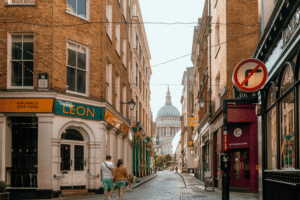
Walk from St Paul’s through the City lanes – Leadenhall Market (a Victorian covered market of extraordinary beauty), the church ruins of St Dunstan in the East (bombed in the Blitz and left as a public garden within the remaining walls), the lanes of the medieval city plan that survived both the Great Fire and the Blitz.
The Sky Garden at 20 Fenchurch Street provides a 360-degree view of the London skyline from a free-entry observation deck – book in advance online.
Afternoon – Greenwich
Take the Clipper river bus from Embankment or the Tower of London pier east to Greenwich – a river journey of approximately 45 minutes that gives the best view of London from the water.
Greenwich is where the Prime Meridian (0° longitude) runs through the earth, and the Royal Observatory on the hill above the park marks it physically – the brass line in the courtyard where east and west meet is one of those geographic gestures that is simultaneously trivial and genuinely satisfying to stand on.

Credit: Max Patel
The National Maritime Museum below the park is free and excellent. The Painted Hall at the Old Royal Naval College – a painted ceiling of extravagant Baroque magnificence that has been described as the British Sistine Chapel – is one of the finest decorated interiors in England.
Lunch or afternoon coffee at Trafalgar Tavern on the Thames waterfront in Greenwich.
Evening – Return to the City or South Bank
Return by river bus or by the DLR and Tube, and spend the final evening in whichever part of the city that has claimed you.
The South Bank at dusk – Tate Modern, the Millennium Bridge, the view of St Paul’s from the river – is the version of London most worth returning to on a last evening. The theatre programme at the National, the Old Vic (a short walk south), or Southwark Playhouse provides the finest London evening for those who want to end with a show.
A drink at the Anchor Bankside – a pub with a history stretching back to the 17th century – with the Thames visible from the terrace, is as specifically London as anything on this four-day itinerary.
Practical Notes for 4 Days in London
Getting around. The London Underground (the Tube) is the fastest way to move between areas. Use a contactless bank card or Apple Pay: it taps in and out on all London public transport, applying the daily fare cap automatically. Walking between central areas takes longer than the map suggests but reveals the city more completely than any transit journey.
Booking ahead. The restaurants listed in this guide – Kiln, Barrafina, Brat, Lyle’s, Ottolenghi – all require advance reservations or accept walk-ins with queues. For a four-day visit, booking two or three dinners before you arrive is sensible. The rest can be spontaneous.
Museum timings. All major London museums – the British Museum, National Gallery, National Portrait Gallery, Tate Modern, Victoria and Albert, Natural History Museum – are free and open daily. Weekday mornings are consistently less crowded than weekend afternoons.
The London Pass or Oyster. For transport alone, the contactless bank card is simpler than the Oyster card for most visitors. For attractions, the London Pass covers most major paid sites; whether it represents value depends on how many ticketed attractions you are planning to visit.
Conclusion
Four days in London will not exhaust it.
But four days, spent as described here, will give you Westminster and the South Bank, the British Museum and the Victoria and Albert, Borough Market and Borough Market’s finest pasta, the East End’s street art and the medieval lanes of the Square Mile, Greenwich and the Thames from the river, and enough of the city’s restaurants and bars to begin forming an opinion about which neighbourhood you will stay in when you return.
Because you will return.
To explore London’s extraordinary culture, neighbourhoods, and food scene as part of a curated private visit, discover our private London tours.
FAQ
Is 4 days enough to see London?
Yes, 4 days is a great amount of time for London. You can visit major landmarks, explore famous neighborhoods, enjoy museums, try British food, and still have time for shopping or a day trip.
What should you not miss in London?
Don’t miss Big Ben, Tower of London, Buckingham Palace, the British Museum, the London Eye, and a walk along the River Thames.
How much money do you need for 4 days in London?
A realistic budget for 4 days in London is around £400–£800 per person, excluding flights, depending on your hotel style and spending habits. Budget travelers can spend less, while central hotels, fine dining, and paid attractions increase costs.
What are the top 6 places to visit in London?
The top six places to visit are Tower Bridge, Buckingham Palace, the Tower of London, Big Ben and Westminster, the British Museum, and the London Eye. These showcase London’s history, royalty, architecture, and culture.