Norwegian food is shaped by the landscape that produced it.
Long winters, an extensive coastline, fjords cutting deep into the interior, mountain farms producing game and dairy during brief summers. These conditions created a cuisine of honest necessity that has, over centuries, become one of great character. Preservation is central to the tradition: salting, drying, curing, fermenting. What began as practical survival has become a culinary identity.
The result is a kitchen that specialises in depth of flavour rather than complexity of preparation. Norwegian food recipes ask for patience, good ingredients, and respect for the process. They are, in the best possible way, unfussy.
This guide covers the essential Norwegian food recipes such as the national dish, the Christmas traditions, the fish preparations, the breads and baked goods, with the detail you need to make them at home.
Key Takeaways
- Norwegian cuisine is rooted in the preservation traditions of a coastal and farming culture: salting, drying, curing, smoking, and fermenting are all central to the pantry.
- Lamb and fish are the two most important proteins in Norwegian cooking – particularly salmon, cod, and herring.
- Fårikål, Norway’s national dish, is one of the simplest recipes in Nordic cooking and one of the most satisfying.
- The Christmas table (julbord) is Norway’s most culturally significant culinary event, centred on pinnekjøtt, ribbe (pork belly), and riskrem.
- Akevitt – Norway’s signature spirit, distilled from grain or potatoes and flavoured with caraway – is the traditional accompaniment to the most celebratory Norwegian food recipes.
Meat Dishes
Fårikål – Norway’s National Dish
Fårikål is the dish that most honestly represents Norwegian cooking.
Two ingredients: lamb and cabbage. They are layered in a pot with whole black peppercorns, covered with water, and left to cook slowly for two to three hours until the meat is completely tender and the cabbage has absorbed the lamb’s fat and the pepper’s warmth into something quietly extraordinary. There is nothing else. No aromatics beyond the pepper, no thickening, no garnish. Just a bowl that smells, unmistakably, of autumn in Norway.
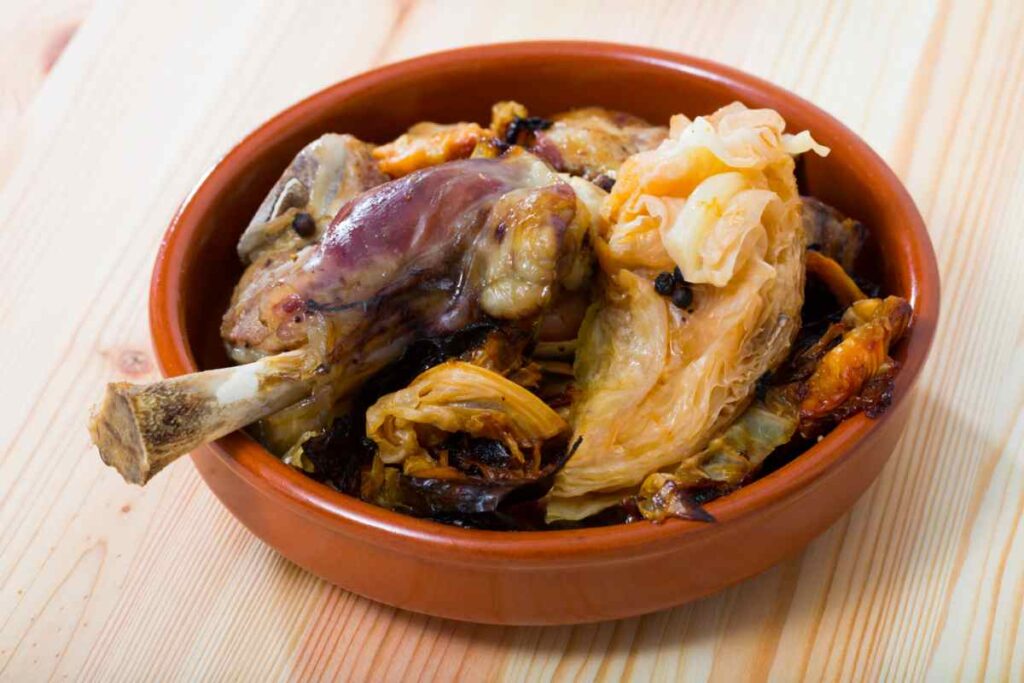
Credit: Campervan Norway
The dish has its own national day: the last Thursday of September, known as Fårikålens dag, when restaurants across the country serve it and families gather around it. The tradition dates from the 19th century, when sheep were slaughtered in autumn as fodder became scarce and cabbage was still plentiful from the fields.
Served with boiled potatoes and a slice of dark bread, fårikål is the most direct expression of what Norwegian food recipes do at their best: take minimal ingredients and give them enough time.
Key ingredients: Bone-in lamb or mutton shoulder (cut into portions), green cabbage, whole black peppercorns, water, salt.
Kjøttkaker – Norwegian Meatballs
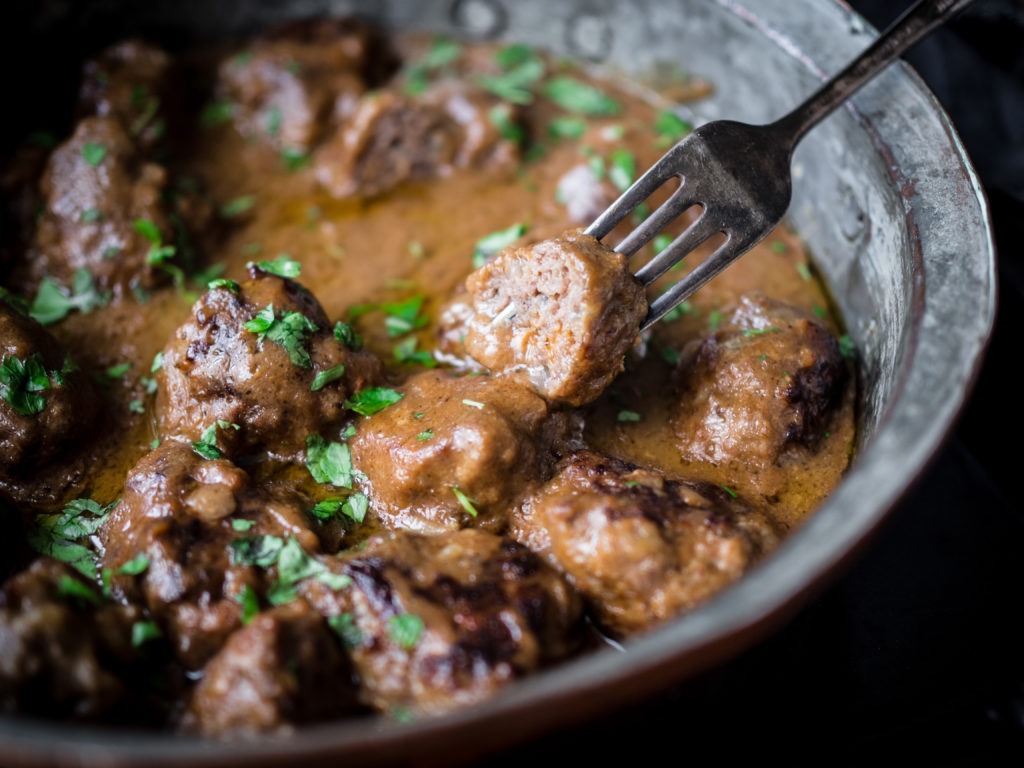
Kjøttkaker are Norway’s version of the Nordic meatball, but larger, flatter, and more robustly seasoned than their Swedish counterparts.
Where Swedish köttbullar are small and served in a cream sauce, Norwegian kjøttkaker are palm-sized oval patties seasoned with nutmeg, ginger, and allspice, pan-fried in butter until golden, and served with a brown gravy (brun saus) made from the pan drippings extended with beef stock. The accompaniments are always the same: boiled potatoes, stewed peas, creamed cabbage or carrots, and a spoonful of lingonberry jam. The lingonberry is not optional. Its tartness is the essential counterpoint to the rich, spiced meat.
Credit: North Wild Kitchen
The name translates literally as “meat cakes,” and historically they were made from minced leftover butcher cuts. Today’s version uses a mixture of beef and pork for the best flavour and texture, with breadcrumbs soaked in milk to give the patties a soft, yielding centre.
Key ingredients: Minced beef and pork, breadcrumbs, milk, egg, nutmeg, ginger, allspice, salt. For the sauce: butter, plain flour, beef stock. Served with: boiled potatoes, lingonberry jam.
Pinnekjøtt – Cured Lamb Ribs at Christmas
Pinnekjøtt is Norway’s most important Christmas dish, and one of the most characterful traditional recipes in Scandinavia.
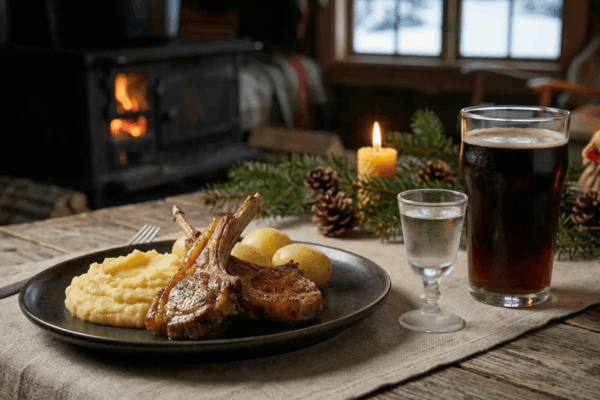
The preparation begins weeks before Christmas: racks of lamb or mutton ribs are dry-cured in coarse salt and then hung in a cool, dark space to dry for six to eight weeks. In some parts of western Norway, they are smoked before drying. The result is a product of concentrated, intensely savoury flavour, not unlike a dry-cured ham in its depth.
Credit: The Nordic Dish
Before cooking, the ribs are soaked in cold water for approximately thirty hours to remove the salt and soften the meat. They are then steamed over a layer of birch branches – the source of the name, which means “stick meat” – or over a rack in a covered pot for two to three hours, until the meat falls cleanly from the bone.
The traditional accompaniment is kålrotstappe, which is a mashed swede or rutabaga, and boiled potatoes. Akevitt is the drink of choice. Pinnekjøtt is particularly associated with western Norway, though it has spread across the country, and about a third of Norwegians now eat it on Christmas Eve.
Key ingredients: Racks of lamb or mutton ribs, coarse sea salt (for curing). To serve: mashed rutabaga or swede (kålrotstappe), boiled potatoes.
Raspeballer – Potato Dumplings
Raspeballer are Norwegian potato dumplings known as komle in Bergen, klubb further north, and by various other regional names, and they represent one of the most deeply embedded of all Norwegian food recipes.
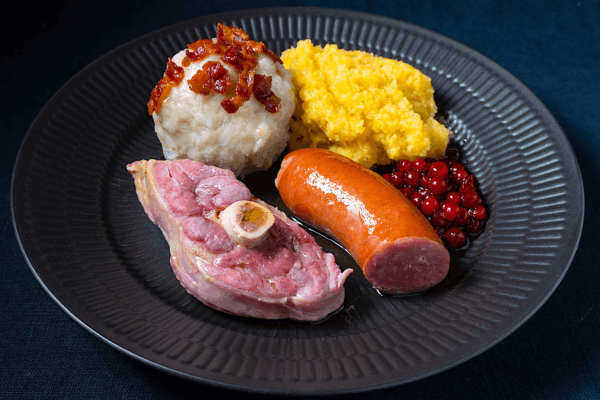
Made from a mixture of raw grated potato, cooked mashed potato, barley or plain flour, and salt, they are formed into large balls roughly the size of a fist and boiled in salted water until cooked through. The texture is dense and satisfying, and the flavour mild, which is by design, since the accompaniments do the seasoning work.
Credit: The Food Dictator
Traditional serving: salted lamb or pork, sliced and browned bacon, and mashed rutabaga, everything assembled on the plate and the dumplings split open to absorb the cooking juices. Some versions include a piece of bacon pressed into the dumpling’s centre before boiling, which renders and seasons from the inside.
Raspeballer are particular to western Norway and the inland regions, where they appear as a Thursday or Saturday fixture on the family table through the colder months.
Key ingredients: Raw potatoes (grated), cooked mashed potato, barley flour or plain flour, salt. Served with: salted meat or pork, bacon, mashed rutabaga.
Fish & Seafood
Gravlaks – Cured Salmon
Gravlaks is one of Norway’s most internationally celebrated food preparations and one of the simplest curing recipes in any cuisine.
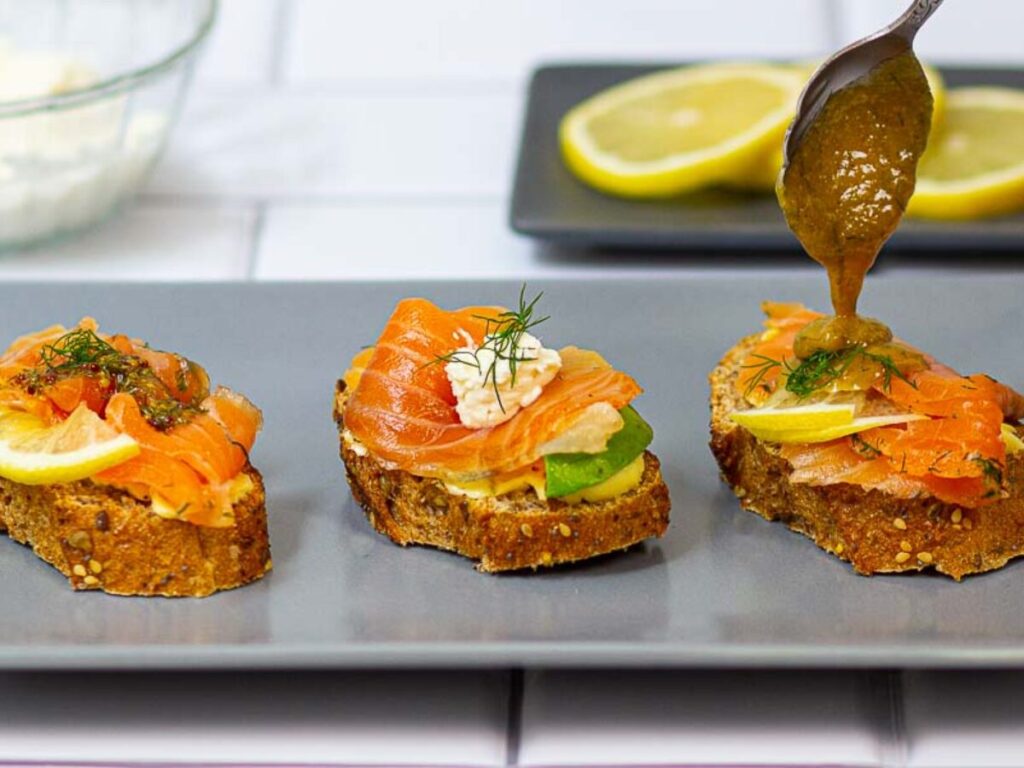
A fresh salmon fillet is buried (grav means buried in Scandinavian languages) under a mixture of coarse salt, sugar, and generous quantities of fresh dill. Pressed under a weight in the refrigerator for twenty-four to forty-eight hours, the cure draws moisture from the flesh and transforms it: firmer, silkier, and deeply flavoured, with the dill woven through every bite.
Credit: My German Recipes
The traditional accompaniment is sennepssaus. It’s a mustard and dill sauce made from Dijon mustard, sugar, white wine vinegar, oil, and fresh dill emulsified slowly to a creamy consistency. Gravlaks is served in thin slices across the grain, on dark rye bread or crispbread, or as a more formal starter with boiled new potatoes.
Unlike smoked salmon, gravlaks are not cooked or heated at any point. The cure preserves and firms the flesh without altering its essential character. The quality of the salmon is everything: cold-water Norwegian salmon, fresh from the fish counter, is the ingredient the recipe was built around.
Key ingredients: Fresh salmon fillet (skin on), coarse sea salt, white sugar, fresh dill, white pepper. For sennepssaus: Dijon mustard, caster sugar, white wine vinegar, vegetable oil, fresh dill.
Fiskesuppe – Norwegian Fish Soup
Fiskesuppe is Norway’s answer to the universal question of what to do with good fish and cold weather: a creamy, delicate soup built from white fish, shellfish, root vegetables, and a rich, lightly enriched broth.
Bergen is particularly famous for its version. This version is thick, cream-enriched, and loaded with salmon, cod, and prawns alongside carrots, leeks, and celeriac in a base of fish stock, white wine, and a small measure of cream. Other regions make leaner, clearer versions built on a more delicate broth. Both are correct, and both reflect the principle that the best fiskesuppe starts with the best fish stock and the freshest ingredients you can find.
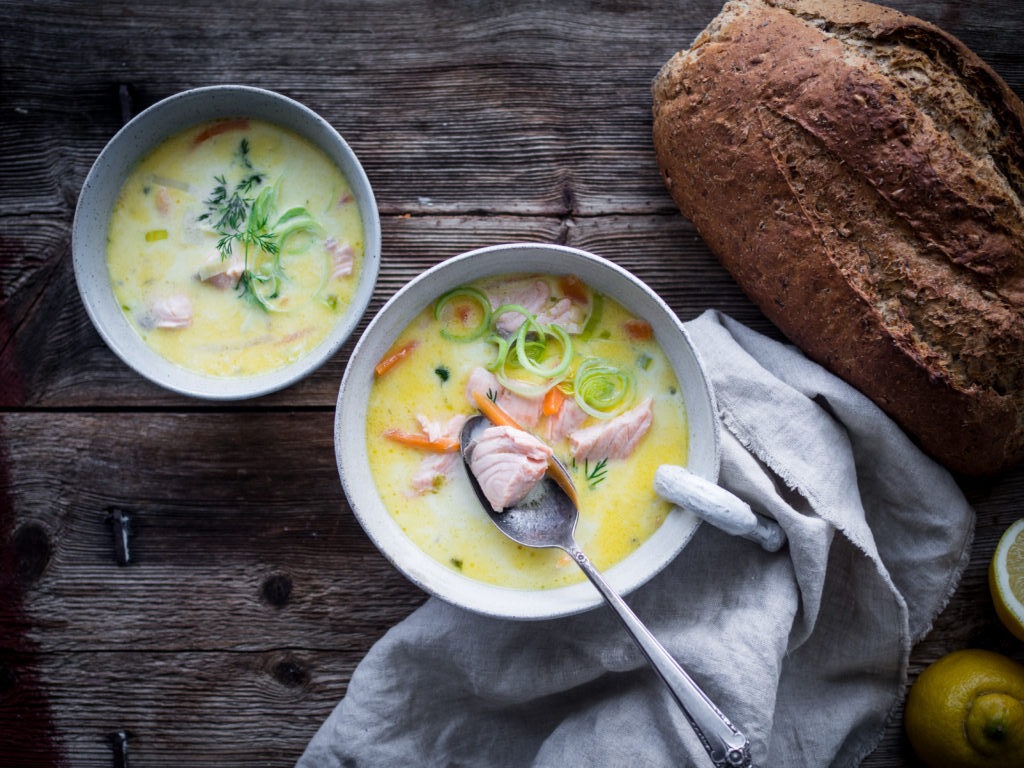
Credit: North Wild Kitchen
The soup is finished with a generous amount of fresh dill or chives, a squeeze of lemon, and served with crusty Norwegian bread to mop the bowl clean. It is a starter in formal contexts; a complete meal in the informal Norwegian kitchen.
Key ingredients: White fish (cod, haddock, or pollock), salmon, raw prawns, carrot, leek, celeriac, fish stock, white wine, double cream, fresh dill, lemon.
Fiskeboller – Fish Balls in White Sauce
Fiskeboller are the weekday fish recipe of Norway. It’s a domestic staple of remarkable simplicity that, at its best, has a silky texture and a clean, sweet flavour that home-made versions achieve far beyond the tinned variety found on every supermarket shelf.
The mixture is made from poached or raw white fish (most traditionally cod) blended or minced with a small amount of flour, milk, salt, and sometimes nutmeg until smooth, then formed into rounds and poached gently in salted water or fish stock. The sauce is a classic white (hvit saus): butter, flour, and fish stock or milk, enriched with a little cream and seasoned with salt and white pepper.
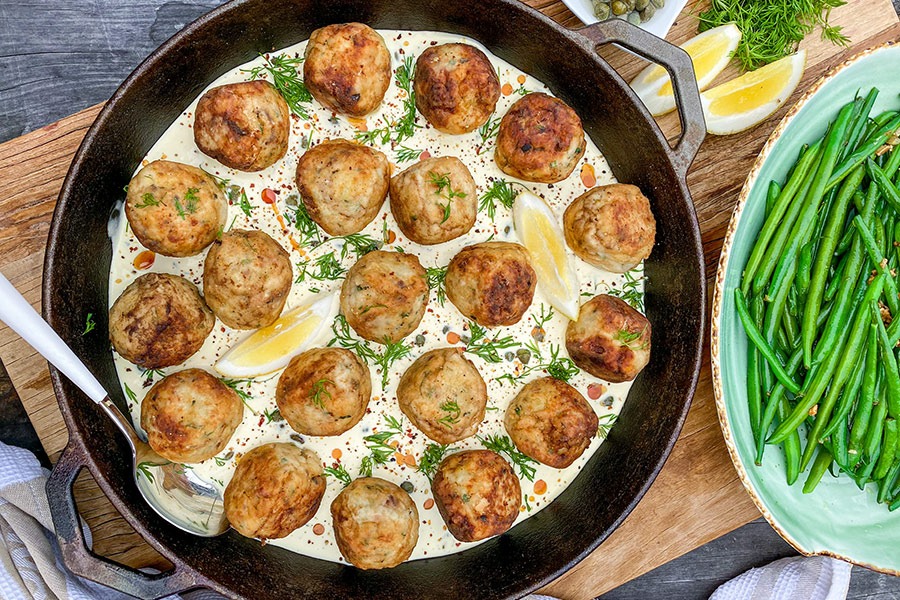
Credit: The Fishing Website
Fiskeboller are served over boiled potatoes with vegetables like asparagus, carrots, or broccoli. The sauce poured generously over everything. They are mild, comforting, and entirely of a piece with the Norwegian domestic tradition of feeding people well with what is available.
Key ingredients: White fish fillets, plain flour, full-fat milk, egg white, salt, nutmeg. For the sauce: butter, plain flour, fish stock or milk, double cream.
Breads, Flatbreads & the Breakfast Table
Lefse – Norwegian Potato Flatbread
Lefse is one of Norway’s oldest and most regionally varied recipes. It’s a thin, soft flatbread made from potato, flour, butter, and cream, cooked on a flat griddle (takke) until just beginning to colour.
The potato gives it a slightly chewy, yielding texture unlike any wheat flatbread, and the flavour is mild and clean. It’s a true blank canvas, as lefse has always been. Sweet versions are served with butter, cinnamon, and sugar, rolled into a tube and eaten warm. Savoury versions wrap smoked salmon and sour cream, or sliced cured meat and strong cheese. The debate over whose family recipe is the correct one is both ongoing and entirely unresolvable.
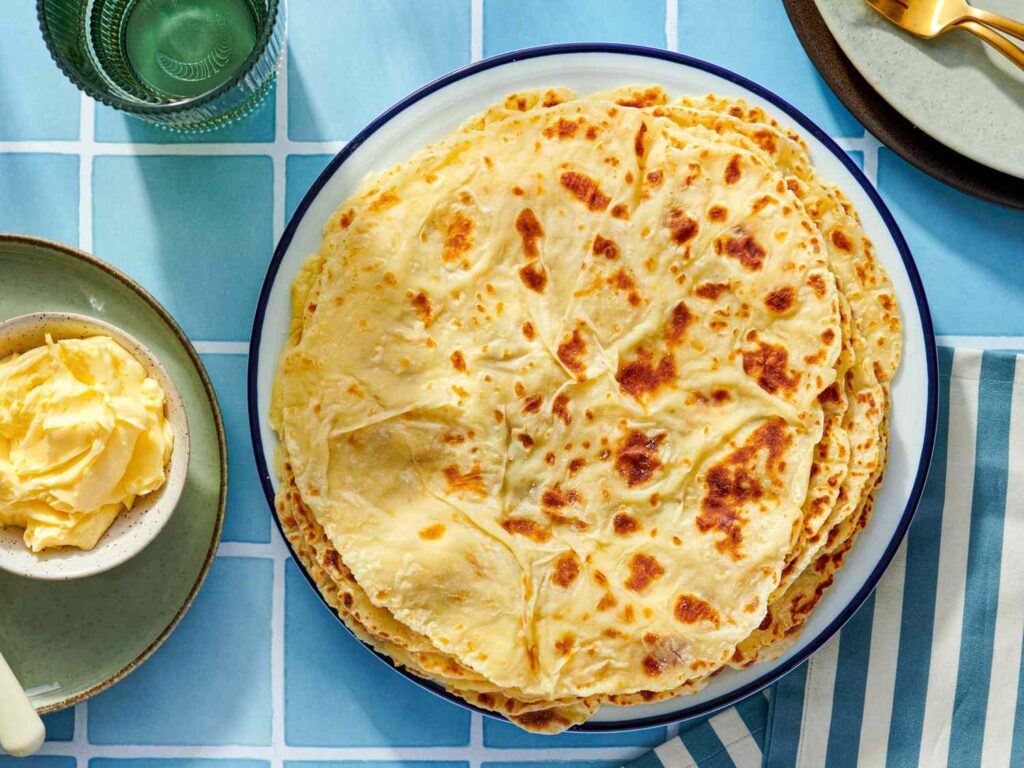
Credit: Serious Eats
Traditionally, lefse was made in large quantities during autumn for storage through winter, stacked between cloth to stay soft. Modern home cooking takes advantage of the griddle or a dry non-stick frying pan; the recipe itself has changed very little.
Key ingredients: Boiled mashed potato (cooled completely), plain flour, butter, double cream or full-fat milk, salt.
Vafler – Norwegian Waffles
The Norwegian waffle is not the Belgian waffle, and Norwegians are clear about this distinction.
Norwegian vafler are thinner, softer, heart-shaped, from a waffle iron specific to Norway, and served in a register quite different from the caramelised, crisp Belgian version. The batter is lightly sweetened with a little cardamom and vanilla, and the result is a tender, faintly fragrant waffle that is almost always eaten warm.
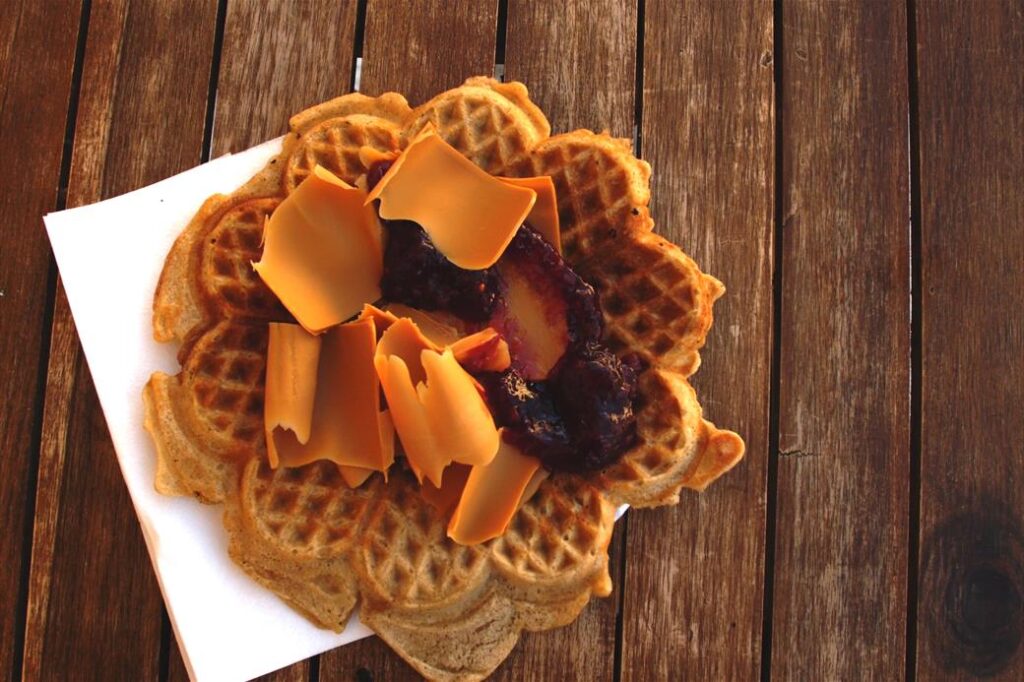
Credit: Visit Oslo
Toppings span a range that reflects the Norwegian pantry: sour cream (rømme) with strawberry jam is the most traditional combination; brunost – the distinctively Norwegian brown cheese – is spread over the warm waffle and melts into the surface; fresh berries with whipped cream make an appearance in summer. The waffle is eaten at all hours in Norway, in mountain lodges, church halls, home kitchens, and ferry terminals, with the coffee pot always nearby.
Key ingredients: Plain flour, butter, eggs, milk, caster sugar, cardamom, vanilla, baking powder. Served with: sour cream and jam, or brunost.
Dairy & Preserves
Brunost – Norwegian Brown Cheese
Brunost is among the most distinctive food products in Scandinavia, and, to those encountering it for the first time, among the most unexpected.
It is not technically a cheese in the conventional sense. Rather, it is made by boiling whey, which is the liquid left over from cheesemaking. Together with milk or cream until the sugars caramelise and the mixture reduces to a thick, fudge-like consistency. The result is a product of deep brown colour, firm enough to slice on an ostehøvel (the cheese plane that Norwegians invented in 1925), with a flavour that is sweet, tangy, and faintly smoky – caramel and goat’s milk in combination.
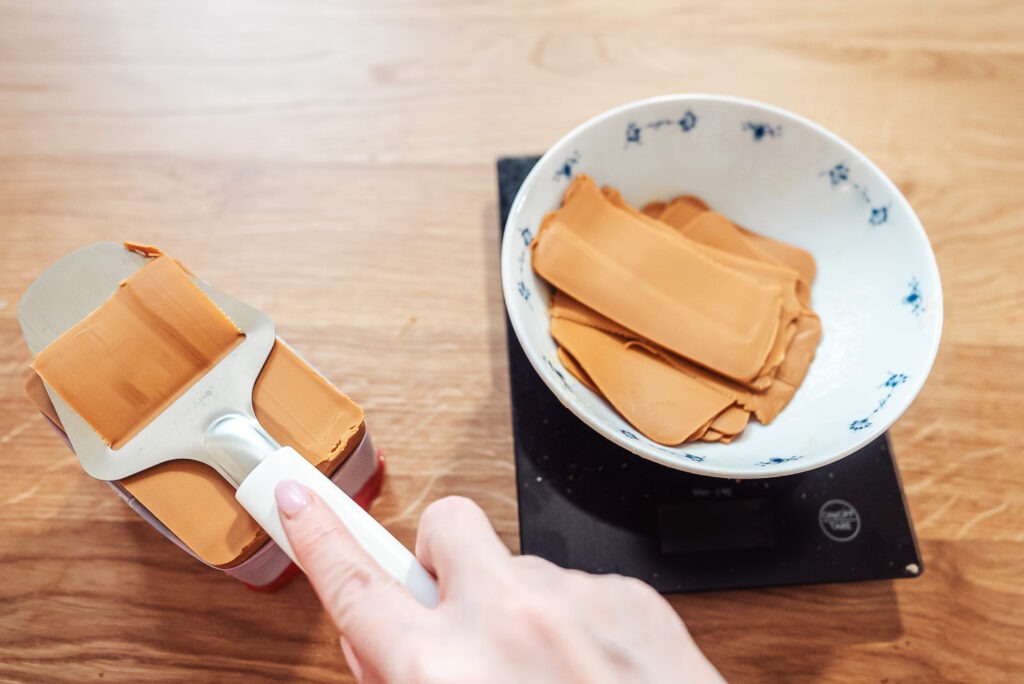
Credit: Scandinavian Cookbook
Brunost made entirely from goat’s milk is known as ekte geitost. It’s a bit stronger and slightly more pungent. The most common variety, Gudbrandsdalsost, blends cow’s and goat’s milk for a milder, sweeter result that is the standard in most Norwegian households.
It is eaten across every meal: at breakfast on crispbread, at lunch in a packed sandwich, melted into stews (particularly reindeer dishes) for depth and sweetness, and on top of fresh vafler at any hour. Norway exports approximately 2,500 tonnes of brunost annually. For those who have grown up with it, it is simply the taste of home.
Key ingredients for home production: Whey (from ricotta or another fresh cheese production), full-fat milk, double cream, sugar. Boil slowly and reduce, stirring constantly, until thick and brown.
Baking & the Sweet Table
Rømmegrøt – Sour Cream Porridge
Rømmegrøt is a dish of deceptive simplicity, and considerable richness.
Full-fat sour cream is cooked slowly in a heavy pan, the fat gradually separating to the surface as the cream reduces. Plain flour is whisked in and the mixture stirred continuously until it thickens to a smooth, glossy porridge. Warm milk is added to achieve the right consistency, and the whole thing is finished with a pinch of salt.
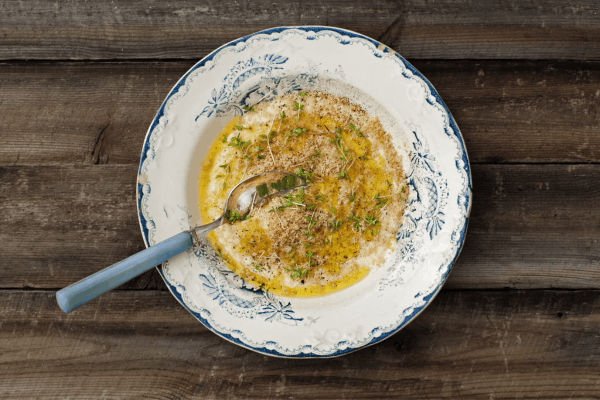
Credit: Rørosmeieriet
It is served in a wide bowl, the surface pressed with a ladleful of the melted butter that separated during cooking, then dusted generously with cinnamon and sugar. The flavour is rich, faintly sour, warm, and entirely its own. It’s not sweet in the way a rice pudding is sweet, but subtly so, with the tang of the sour cream running underneath everything.
Rømmegrøt is a summer dish at mountain farms (seters), a Christmas table tradition, and the accompaniment to fenalår (Norway’s dried and salted leg of lamb) at festive gatherings. It is one of those recipes that requires no complexity because the ingredients, handled correctly, do everything themselves.
Key ingredients: Full-fat sour cream (rømme), plain flour, full-fat milk, salt. Served with: melted butter, cinnamon, sugar. Often accompanied by cured meats and crispbread (flatbrød).
Kransekake – Ring Cake for Celebrations
Kransekake is Norway’s great celebration cake. Imagine a tower of concentric almond rings stacked and iced with a white royal icing, assembled into the shape of a Christmas tree or a tall cone depending on the occasion.
The rings are made from a dough of ground almonds, icing sugar, and egg whites, piped or rolled into graduated rings and baked until they develop a slight crust on the outside while remaining soft and chewy within. The flavour is pure marzipan. Its taste is deeply almond, sweet, with a slightly crisp surface, and the construction, once assembled.

Credit: The Spruce Eats
Kransekake appears at weddings, confirmations, national celebrations, and Christmas throughout Norway. On the 17th of May, we have Norway’s national day. And on this day, it is everywhere. It is made in dedicated kransekake tins, and the technique of achieving the right texture, firm enough to hold shape, soft enough to yield pleasantly, is one of those skills passed through families rather than easily learned from a recipe alone.
Key ingredients: Ground almonds (blanched), icing sugar, egg whites. For the icing: icing sugar, egg white, lemon juice.
Multekrem – Cloudberry Cream
Cloudberries grow in the Arctic bogs of northern Norway and Lapland, and their season is brief enough that most people who pick them do so with the focused intensity of something genuinely rare.
They look like amber raspberries and taste entirely unlike anything cultivated. The taste is faintly tropical, complex, with a tartness that is simultaneously fruity and wine-like. When stirred into freshly whipped cream with a little sugar, the result is one of the purest and most characteristically Norwegian desserts: multekrem.
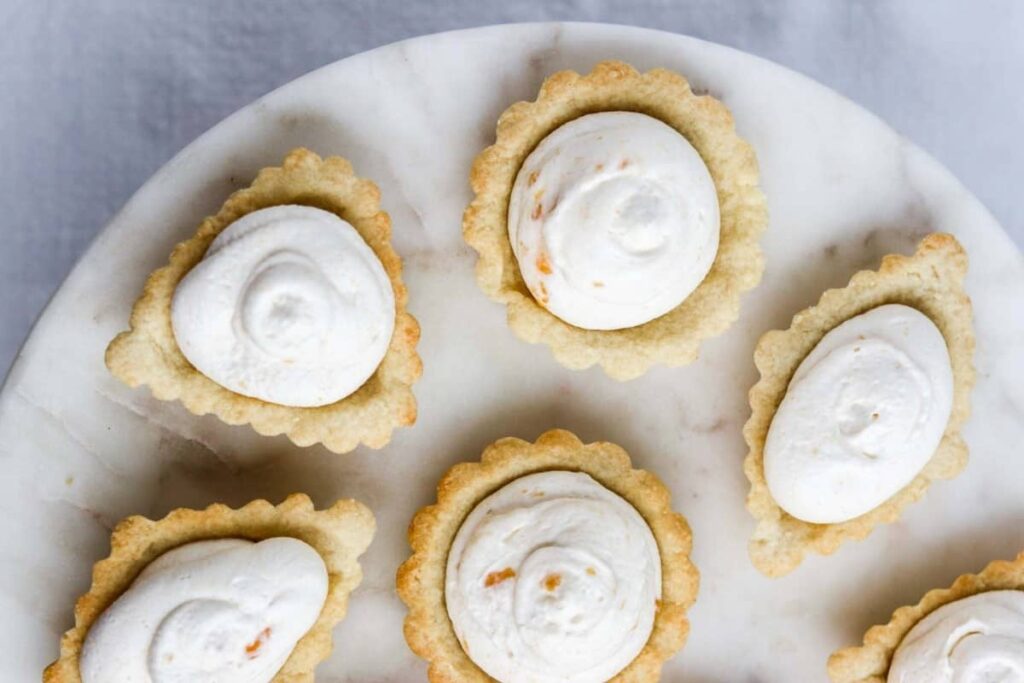
Credit: True North Kitchen
It is served at Christmas, at weddings, and on the most significant occasions, partly because the berries are expensive when bought commercially, and partly because cloudberry cream has always carried the weight of celebration. Eaten with a thin waffle or a krumkake cone, it is a very good way to end a meal.
Key ingredients: Cloudberries (fresh or frozen), double cream, caster sugar. Served with: krumkake or Norwegian waffles.
Conclusion
Norwegian food recipes are the product of a landscape and a climate that required ingenuity, patience, and a deep respect for what was available.
Cured lamb ribs steamed over birch branches, salmon buried in salt and dill, potato dumplings served with salted meat, sour cream porridge finished with melted butter and cinnamon. These are not complicated preparations. They are careful ones. And the care shows in the eating.
Whether you make fårikål on a cold October Sunday, serve gravlaks at a Christmas gathering, or simply find a Norwegian waffle iron and spend a Saturday morning learning what sour cream and brunost can do together, Norwegian food rewards the effort of cooking it with the same honest warmth that defines the country itself.
To experience Norwegian food in its full cultural and natural context, explore our private Oslo tours and Nordic travel experiences – crafted for travellers who want to go deeper into one of the world’s most extraordinary destinations.
FAQ
What is Norway's most popular food?
Salmon is Norway’s most popular food, enjoyed fresh, smoked, or cured domestically and exported worldwide. Norwegians also frequently eat brunost (brown cheese), grandiola (open-faced sandwiches), meatballs, and surprisingly, tacos have become a beloved weekly tradition. Hot dogs (pølse) from street vendors, waffles with brown cheese, and various seafood dishes remain everyday favorites throughout Norway.
What is a traditional Norwegian dish?
Traditional Norwegian dishes include fårikål (lamb and cabbage stew), lutefisk (dried fish in lye), rakfisk (fermented trout), kjøttkaker (meatballs), and raspeballer (potato dumplings). Seafood features prominently with salmon, cod, and shrimp preparations. Other classics include pinnekjøtt (cured lamb ribs), smalahove (sheep’s head), brown cheese (brunost), lefse flatbread, and various cured meats reflecting Norway’s preservation traditions.
What is the national dish of Norway?
Fårikål is Norway’s official national dish, a hearty autumn stew combining mutton or lamb with cabbage, black peppercorns, and water, slow-cooked until tender. Voted national dish in 1972 and reaffirmed in 2014, it’s traditionally served with boiled potatoes during September and October. Fårikål Day is celebrated annually on the last Thursday in September, when Norwegians nationwide enjoy this beloved comfort food.
What is a common breakfast in Norway?
Common Norwegian breakfast includes open-faced sandwiches (brødskiver) with cheese, cold cuts, kaviar (cod roe spread), cucumber, and tomato. Brunost (brown cheese) is extremely popular. Many eat porridge (grøt), yogurt with muesli, or knekkebrød (crispbread). Boiled eggs, smoked salmon, and mackerel appear frequently. Coffee is essential. Weekend breakfasts may include scrambled eggs, bacon, or fresh baked goods.