Skiing in Finnish Lapland is a different proposition from skiing in the Alps.
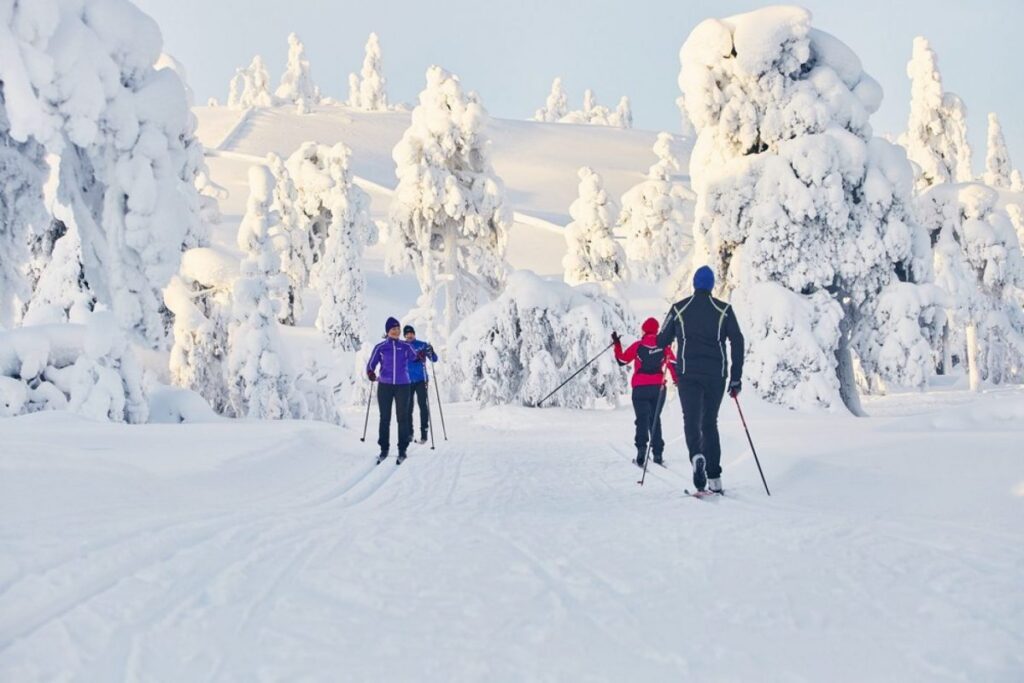
The mountains are fells rather than peaks. They are rounded, snow-covered, and wide rather than dramatic and vertical. The pistes are shorter than those in Chamonix or Verbier, and the après-ski, in most resorts, happens around open fires and glasses of Glögi rather than in mirrored clubs. What Finnish Lapland offers in exchange is something the Alpine world genuinely cannot: skiing in complete polar darkness in January, with the Northern Lights sometimes appearing above the runs; skiing under an enormous Arctic sky with temperatures cold enough to keep the powder dry for weeks; skiing surrounded by snow-laden pine forests, frozen lakes, and a landscape that looks like the set of a fairy tale.
Finnish Lapland also offers extraordinary value compared to any other European destination. Lift passes, accommodation, and food cost significantly less than equivalent Alpine resorts. The infrastructure is modern and well-maintained. The ski schools are excellent and well-staffed with English speakers. And the combination of skiing with reindeer safaris, snowmobile tours, husky sledging, and Northern Lights hunting (available at every major resort) gives a Lapland ski holiday a range of experiences that purely skiing destinations cannot match.
This guide covers the main Lapland, Finland ski resorts, their characteristics, their strengths, and how to choose the right one for your trip.
Key Takeaways
- Finland’s Lapland ski season runs from approximately November to May – one of the longest in Europe – with late February to mid-March generally considered the optimal window combining good snow, daylight, and Northern Lights potential.
- Levi is Finland’s largest and most international ski resort, voted Finland’s Best Ski Resort by the World Ski Awards in 2023. It is the most complete resort for those who want skiing, nightlife, and full resort amenities in one place.
- Ylläs has more slopes than any other Finnish resort (63 slopes across two villages) and is the best choice for intermediate and advanced skiers who want variety.
- Ruka, in eastern Lapland near Oulanka National Park, combines solid downhill skiing with 500 kilometres of groomed cross-country trails and is the most adventure-focused resort.
- Saariselkä is Europe’s northernmost ski resort and the best choice for those who prioritise remoteness, tranquillity, and maximum Northern Lights opportunity.
- All major Lapland ski resorts are served by dedicated airports – Kittilä for Levi and Ylläs, Kuusamo for Ruka, Ivalo for Saariselkä, and Rovaniemi for Pyhä and Luosto.
The Major Lapland Ski Resorts
Levi
Location: Kittilä municipality, northwestern Lapland
Airport: Kittilä (15 km)
Slopes: 43 slopes, 27 lifts
Vertical: 325 metres Longest run: 2,500 metres
Season: November to early May
Levi is Finland’s largest and most celebrated ski resort. It’s a purpose-built ski village in the municipality of Kittilä, served by its own airport less than 15 kilometres away, with ski-in/ski-out accommodation and a resort infrastructure that competes with mid-size Alpine destinations.
Voted Finland’s Best Ski Resort by the World Ski Awards in 2023, Levi has 43 slopes spread across all aspects of its fell, covering every ability level from wide, gentle blues ideal for beginners and families to steeper reds and the challenging Levi Black area for advanced skiers. Night skiing operates until 8 pm throughout the season, and the combination of floodlit slopes and a clear Arctic sky creates the specific Levi experience that no Alpine resort can replicate: skiing under stars so bright they cast faint shadows on the snow.
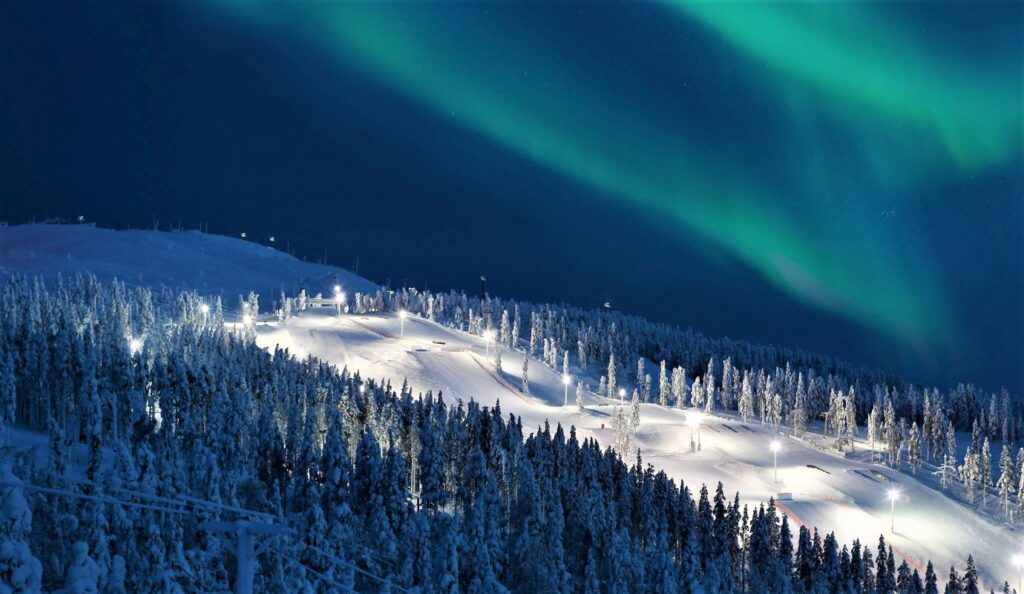
Credit: Discovering Finland
The resort village is Lapland’s most developed. It has an offering of endless restaurants, shops, spa facilities, and an après-ski scene centred on Hissitalli and the various hotel bars make Levi the choice for visitors who want skiing combined with the full range of resort social life. The Lastenmaa Kids’ Land provides purpose-built beginner terrain for children, and the English-speaking ski school is considered among the best in Finland.
Beyond the slopes, Levi’s position in the heart of Lapland makes it an excellent base for snowmobile safaris, husky sledging, reindeer farm visits, and Northern Lights tours – the full range of Lapland winter activities is available through resort operators.
Best for: First-timers, families, those who want the full resort experience, and après-ski.
Ylläs
Location: Kolari municipality, northwestern Lapland
Airport: Kittilä (45 km)
Slopes: 63 slopes, 29 lifts across two linked village areas
Vertical: 463 metres
Longest run: 3,000 metres
Season: November to May
Ylläs is Finland’s largest ski resort by slope count. There are 63 runs across two connected village areas, Ylläsjärvi and Äkäslompolo, linked by the fell itself and the most varied ski terrain in Lapland. The vertical drop of 463 metres is Finland’s largest, making Ylläs the best choice for intermediate and advanced skiers who want proper gradient rather than gentle terrain.
The two village areas have distinct characters. Äkäslompolo, on the western side, is the more traditional and family-friendly village, with views toward the Pallas-Yllästunturi National Park that stretch to the horizon on clear days. Ylläsjärvi, on the eastern side, has a gondola lift and a more developed service base. Skiers can move between the two during the day and return to either village for the evening.
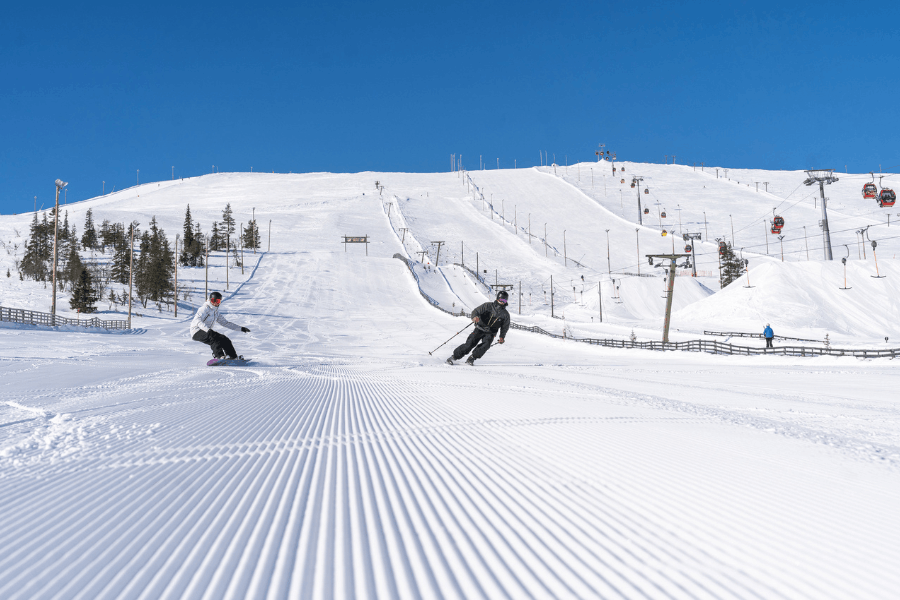
Credit: Ylläs Ski Resort
One of Ylläs’s most distinctive features is its commitment to Northern Lights viewing: from October to February, street lights across the resort are turned off each evening to preserve the darkness needed for aurora sightings. The combination of good skiing, Finland’s best vertical drop, and the best institutional commitment to Northern Lights viewing makes Ylläs one of the most complete Lapland ski resorts.
Ylläs is part of the Pallas-Yllästunturi National Park area, and cross-country skiing directly into the park’s 500-kilometre trail network is available from the resort.
Best for: Intermediate and advanced skiers, Northern Lights hunting, those who want Alpine-feeling vertical in a Lapland setting.
Ruka
Location: Kuusamo, eastern Finland (technically sub-Arctic rather than Arctic Circle, but considered Lapland in the ski context)
Airport: Kuusamo (25 km)
Slopes: 38 slopes, 18 lifts
Vertical: 238 metres
Longest run: 1,350 metres
Season: October to May
Ruka is the most adventure-oriented of the major Finnish ski resorts. It’s a destination where the skiing is genuinely good, but the landscape and the national parks surrounding it are as important as the runs themselves.
It’s situated on the edge of Oulanka National Park, which is one of Finland’s most spectacular protected landscapes, known for its canyon rivers, primaeval forests, and the famous Bear’s Ring hiking trail. Ruka combines downhill skiing with 500 kilometres of groomed cross-country trails that extend into the national park. Regular World Cup events have been held at Ruka, reflecting the quality of its facilities and course preparation. The ski school has strong English-speaking provision, and the resort is particularly well regarded for its beginner teaching facilities on the Ruka Valley side.
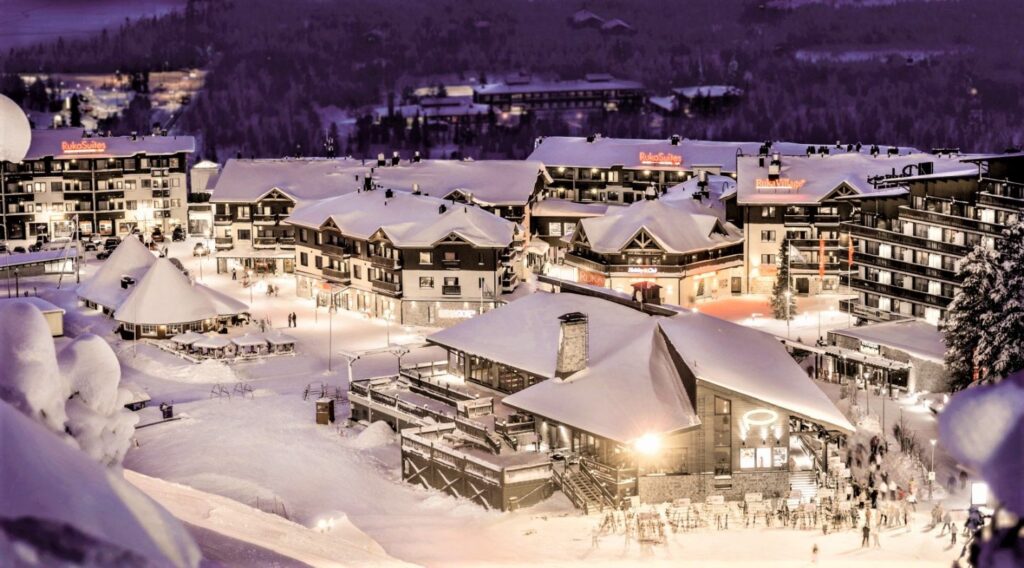
Credit: Discovering Finland
Ruka’s position in eastern Finland means it benefits from a continental climate that offers drier and more reliable snowfall than the more oceanic west, and the season often runs from October, earlier than any other major Finnish resort. The proximity to Oulanka National Park gives Ruka a wilderness character that the more developed Levi does not have.
Best for: Cross-country skiers, adventure seekers, those who want national park access alongside downhill skiing, and early-season skiing.
Saariselkä
Location: Inari municipality, northernmost Lapland
Airport: Ivalo (20 km)
Slopes: 15 slopes, 12 lifts
Vertical: 180 metres
Longest run: 2,000 metres
Season: November to May
Saariselkä holds a distinction that matters in the context of Lapland: it is Europe’s northernmost ski resort, sitting at 68° North above the Arctic Circle and bordering the Urho Kekkonen National Park. That’s Finland’s largest protected area, encompassing 2,550 square kilometres of wilderness.
The skiing at Saariselkä is modest in scale with 15 slopes, with 50% rated as beginner-friendly, and the remaining runs accessible to intermediate skiers. This is not a destination for advanced or technically demanding skiing. What Saariselkä offers instead is the most remote, most atmospheric, and most genuinely wild Lapland ski experience available in Finland: a small resort at the edge of one of Europe’s largest national parks, in the polar night of deep winter, with the best Northern Lights potential of any Finnish ski resort due to its extreme northern latitude and minimal light pollution.
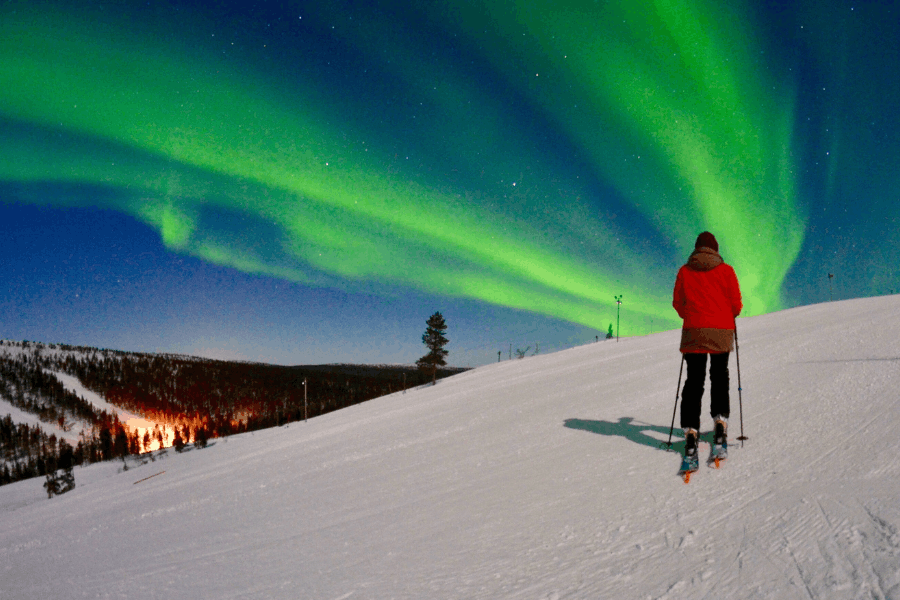
Credit: Snow Online
Seven of the 15 slopes are illuminated, and the ski area operates comfortably into the polar night months of December and January when daylight is minimal or absent. The absence of a traditional après-ski scene is not a deficiency here but part of the point. Saariselkä’s evenings are spent watching the Northern Lights from the fell, not in a bar.
Best for: Northern Lights hunters, beginners, families who want an authentic wilderness experience, and those for whom the landscape matters more than the skiing.
Pyhä
Location: Pelkosenniemi, eastern Lapland
Airport: Rovaniemi (170 km) or Kemijärvi
Slopes: 28 slopes, 9 lifts
Vertical:280 metres
Longest run: 3,000 metres
Season: November to May
Pyhä is the most scenically dramatic of the Finnish ski resorts. It’s a fell of striking geological character, with ravines, cliffs, and ancient pinewoods giving it a wilder, more Nordic feel than the more purpose-built resort villages of Levi and Ruka.
The slopes span every ability level, with some of the steepest and most challenging terrain in Lapland for advanced skiers, alongside a genuine beginner area. The resort village is smaller and quieter than Levi, and the overall atmosphere is relaxed and family-friendly. Pyhä-Luosto National Park borders the resort directly, and wilderness activities are part of the resort’s identity.
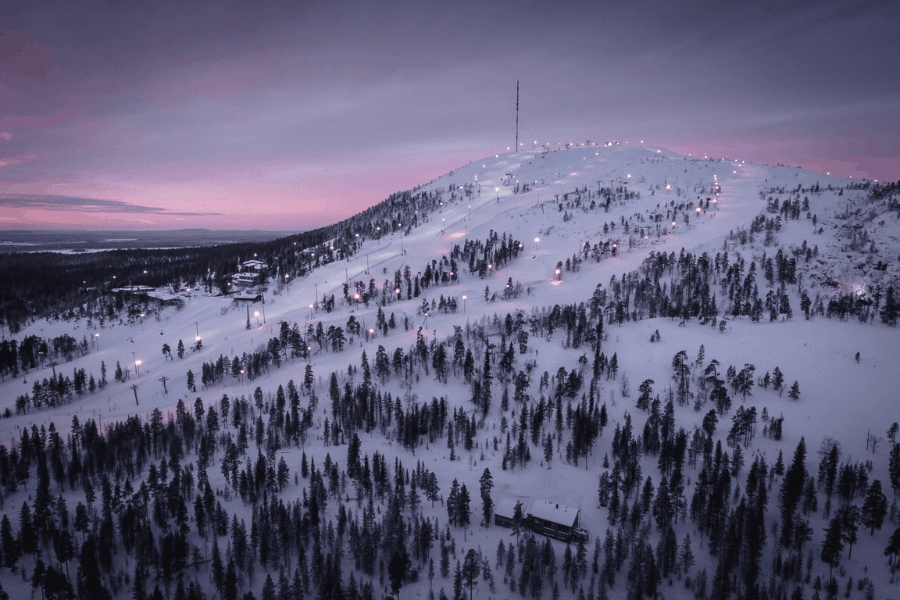
Credit: Discovering Finland
Best for: Advanced skiers, scenery, and those who want a quieter resort with dramatic terrain.
Luosto
Location: Sodankylä, central Lapland
Airport: Rovaniemi (130 km)
Slopes: 11 slopes, 4 lifts
Vertical: 170 metres
Season: November to May
Luosto is the smallest of the major Finnish ski resorts and the most deliberately tranquil. It’s a modest fell with gentle slopes suited entirely to beginners and families, in a setting of traditional Lapland wooden buildings and pine forest.
Credit: Luosto Ski Resort
The resort’s character is less about skiing and more about the wider winter Lapland experience: reindeer safaris depart from the village, husky kennels are adjacent, and the Amethyst Mine on the fell, where visitors can search for Finland’s national gemstone, is one of Luosto’s most distinctive attractions.
Best for: Complete beginners, young families, those for whom winter activities beyond skiing are the primary attraction.
Choosing the Right Resort
For the most complete ski resort experience: Levi. The infrastructure, the variety of terrain, the amenities, and the proximity to Kittilä Airport make it the default choice for first-time visitors to Lapland who want everything in one place.
For the best skiing: Ylläs. More slopes, more vertical, more variety than any other Finnish resort, with the added advantage of Northern Lights-optimised darkness policy and access to the national park trail network.
For maximum Northern Lights potential: Saariselkä or Ylläs. Saariselkä’s extreme northern latitude and complete absence of light pollution make it statistically the best Northern Lights resort in Finland; Ylläs’s deliberate street-light policy makes it the best of the larger resorts.
For adventure and cross-country: Ruka. The combination of Oulanka National Park access, 500 kilometres of groomed cross-country trails, and solid downhill skiing in a wilderness setting is unique in Finnish Lapland.
For families with young children: Levi or Saariselkä. Both have specifically designed beginner and family areas; Levi has the most developed children’s facilities (Lastenmaa Kids’ Land), while Saariselkä offers the gentlest terrain overall.
When to Go
November to January (Polar Night): Minimal daylight with only around 2 to 4 hours in Saariselkä, slightly more at Levi and Ruka. The best Northern Lights conditions. Skiing under floodlights and stars. A genuinely extreme Arctic experience.
Late February to mid-March: The optimal window. Days have lengthened to 8–10 hours of good light. Snow reliability is at its peak. Northern Lights remain active on clear nights. The temperature is cold but manageable. The best combination of skiing and aurora-hunting.
April to May: Long days, excellent snow, and a unique spring light on the Arctic landscape. The skiing is good and often underestimated. Northern Lights are less reliable as nights shorten. Accommodation costs are at their most reasonable.
Practical Notes
Getting there: Kittilä Airport serves Levi and Ylläs; Kuusamo Airport serves Ruka; Ivalo Airport serves Saariselkä; Rovaniemi Airport serves Pyhä and Luosto. Finnair operates direct and connecting services to all of these from Helsinki. Several European airlines run seasonal winter charters to Kittilä and Ivalo specifically for ski holidays.
Ski passes: Day pass prices in Finnish Lapland are considerably lower than those in equivalent Alpine resorts. Multi-day and week passes represent exceptional value.
Equipment rental: Full ski equipment rental is available at every major resort, with quality that matches any European standard. Ski clothing rental is also widely available, which is useful given the extreme temperatures.
Accommodation: Every resort offers a range of options from glass igloos and wilderness lodges through to resort apartments and standard hotel rooms. Glass igloos, aurora cabins, and treehouse accommodations are available near all major resorts and should be booked well in advance for December and February.
Conclusion
The Lapland Finland ski resorts offer something genuinely different from any Alpine skiing experience. It’s not better in every technical respect, but unique in the character of the landscape, the quality of the light, the wildlife, and the complete winter environment that surrounds every run.
Skiing down a floodlit slope in January with the Northern Lights beginning to appear above the treeline is not an experience available in Switzerland or Austria. It is available in Finnish Lapland, at every major resort on this list, between November and April.
To experience Finnish Lapland’s ski resorts and extraordinary winter landscapes as part of a curated Nordic journey, explore our private Helsinki tours and Nordic travel experiences.
FAQ
What are the best ski resorts in Lapland?
Top ski resorts in Lapland include Levi, Ylläs, and Saariselkä. Levi is the most developed with nightlife and events, Ylläs is the largest in terms of slopes, and Saariselkä is quieter and ideal for beginners and northern lights views.
Is there good skiing in Lapland?
Yes, skiing in Lapland is excellent for all levels. It offers long snowy seasons, well-maintained slopes, minimal crowds, and unique Arctic scenery. While not as high-altitude as the Alps, it’s great for beginners and relaxed skiing.
What are the big 3 ski resorts?
The “big 3” in Lapland are usually Levi, Ylläs, and Pyhä-Luosto. These resorts offer the most infrastructure, ski variety, and visitor services, making them the most popular destinations for international travellers.
How much does it cost to ski in Lapland?
Skiing in Lapland typically costs €40–€60 per day for lift passes, with ski rentals around €30–€50 daily. Accommodation varies widely, but overall costs are higher in peak winter due to demand and Arctic tourism popularity.