Iceland has an estimated 10,000 waterfalls. That figure alone tells you something about the kind of country this is. Iceland is shaped so fundamentally by volcanic activity, glacial meltwater, and the slow work of ancient forces that waterfalls are not so much a highlight as a constant. They appear around bends in the Ring Road without announcement. They tumble off sea cliffs that used to mark Iceland’s coastline before the land shifted outward. They erupt from lava fields, thread through narrow gorges, and drop from glaciated mountains with a power that makes the ground beneath your feet feel uncertain.
What makes the waterfalls of Iceland genuinely extraordinary is not just their number but their diversity. No two feel alike. Seljalandsfoss invites you behind its curtain. Svartifoss frames itself in a cathedral of basalt columns. Dettifoss is overwhelmed with sheer volcanic force. Dynjandi fans out like a bridal veil over an entire mountainside in the remote Westfjords. Goðafoss carries the weight of a thousand years of history. Each one reflects a different facet of the same spectacular island, and each one is worth a journey of its own.
This guide covers the essential waterfalls in Iceland, organised by region, with the details you need to plan a visit that does justice to each one.
Key Takeaways
- Iceland is home to approximately 10,000 waterfalls, making it one of the most waterfall-dense countries in the world.
- The South Coast contains the greatest concentration of accessible and celebrated waterfalls, including Seljalandsfoss, Skógafoss, and Svartifoss.
- Gullfoss, part of the Golden Circle route, is Iceland’s most visited waterfall and one of the most powerful in Europe.
- Dettifoss in northern Iceland holds the title of Europe’s most powerful waterfall by volume, fed by Vatnajökull – the continent’s largest glacier.
- Many of Iceland’s finest waterfalls are free to visit; in most cases, the only fee is for parking.
- Iceland’s waterfalls change dramatically between summer and winter – partially frozen cascades and ice formations make winter visits uniquely beautiful, but occasionally restrict access to certain paths.
South Coast Waterfalls
Seljalandsfoss
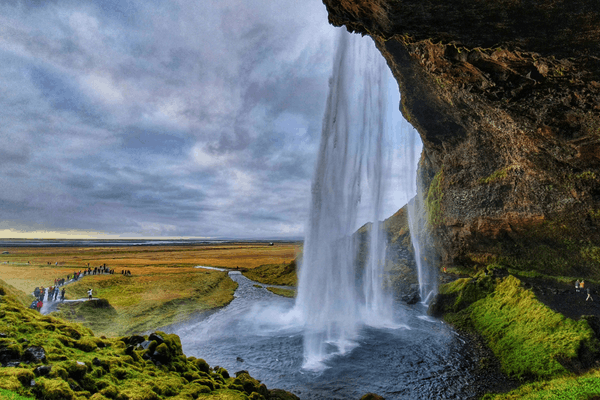
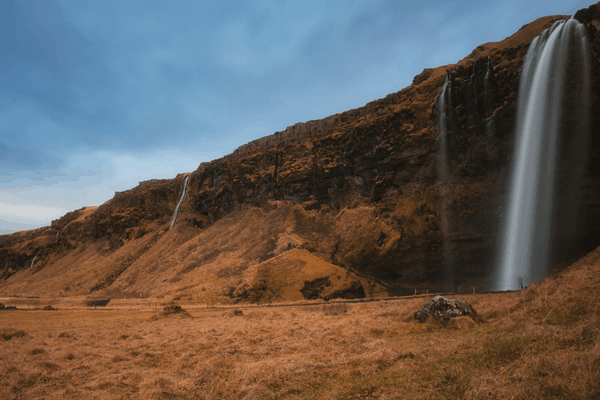
Seljalandsfoss is the most visited and most photographed waterfall in Iceland, and its fame is entirely earned. The 60-metre cascade drops from the cliffs that used to mark Iceland’s ancient coastline, the land having extended outward over millennia. What makes Seljalandsfoss unique among all the waterfalls in Iceland, and among very few waterfalls anywhere on earth, is that a path carved into the cliff face allows visitors to walk completely behind the curtain of falling water.
Standing in the shallow cavern behind Seljalandsfoss, watching the cascade fall in front of you while the landscape appears through a veil of mist and sound, is one of those experiences that exceeds its own photographs. The light changes the scene entirely depending on the hour and the season: golden in summer late evenings when the sun hangs low; glacial and blue-white in winter when the path freezes and ice forms along the cliff walls.
The walk behind the falls is open in summer and typically closed in icy conditions during winter, as the path becomes dangerously slippery. Waterproof clothing is not optional here. You will absolutely get wet, and the experience is better for accepting that. The waterfall is fed by the Seljalandsá River, which originates at the Eyjafjallajökull glacier (the volcano whose 2010 eruption disrupted European aviation for weeks).
Seljalandsfoss is easily accessible from the Ring Road in south Iceland, approximately 1 hour and 45 minutes from Reykjavik, making it a natural first stop on any South Coast day trip.
Credit: Pavol Svantner
Gljúfrabúi
A few hundred metres north of Seljalandsfoss, concealed in a narrow moss-covered gorge that you would easily walk past without knowing it was there, Gljúfrabúi is the closest thing Iceland has to a secret. The waterfall drops 40 metres into an enclosed rock chamber that can only be reached by wading through a shallow stream at the base of the gorge. It’s a short, slightly absurd, entirely delightful scramble that opens into a cathedral of dripping stone and falling water.
The name translates loosely as “Canyon Dweller,” which captures the spirit of it perfectly. Gljúfrabúi is surrounded by dense green moss on every surface, the light filters in from above in a narrow shaft, and the sound inside the chamber is wholly enclosed. It’s truly a world of its own, just metres from one of Iceland’s most popular tourist stops.
Waterproof footwear is essential for reaching the interior. Those who prefer to stay dry can observe the waterfall from a raised viewing platform above the gorge entrance, though this gives only a partial view. Gljúfrabúi is free to visit and shares a parking area with Seljalandsfoss.
Credit: Jan Brennenstuhl
Skógafoss
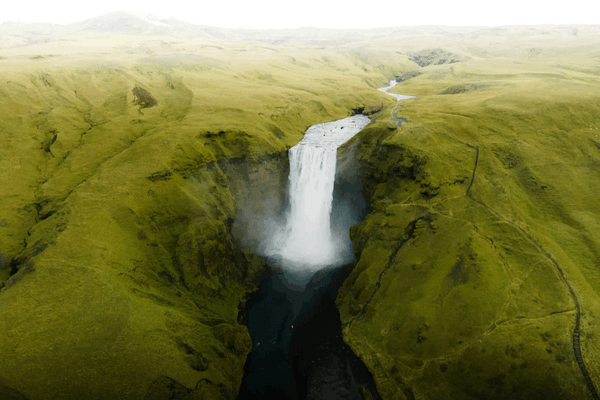
If Seljalandsfoss is famous for what you can do there, Skógafoss is celebrated for what it simply is. It’s a waterfall of such physical perfection and raw power that it consistently appears on lists of the most beautiful waterfalls in Iceland. At 60 metres tall and 25 metres wide, it falls in a near-perfect straight curtain from the cliffs above, generating enough spray to produce almost permanent rainbows on sunny days. A wall of mist drifts across the lower viewing area, coating everything with fine water droplets and giving the base of the falls its own small climate.
Like Seljalandsfoss, Skógafoss marks the line where Iceland’s ancient coastline once stood. The cliffs behind it are part of the same geological formation, pushed further inland over thousands of years. The waterfall is fed by the Skógá River, which originates at the Eyjafjallajökull and Mýrdalsjökull glaciers.
A staircase of 527 steps climbs the eastern side of the waterfall to the top. The effort is significant, but the reward is a dramatic view looking down the length of the falls with the black sand coast and the sea visible in the distance. From this viewpoint, the Fimmvörðuháls hiking trail begins. It’s a multi-day route that passes through 25 smaller waterfalls between the Eyjafjallajökull and Katla glaciers, widely considered one of the most beautiful hiking trails in Iceland.
According to local legend, the first Viking settler in the Skógar area hid a chest of gold behind the waterfall. The chest was supposedly found generations later, but when locals grabbed the ring attached to it, the chest sank back into the water and was never seen again. The ring is said to still hang in the church at Skógar. Skógafoss is free to visit, with a large parking area directly in front of the falls, approximately 30 minutes east of Seljalandsfoss along the Ring Road.
Credit: Tomáš Malík
Kvernufoss
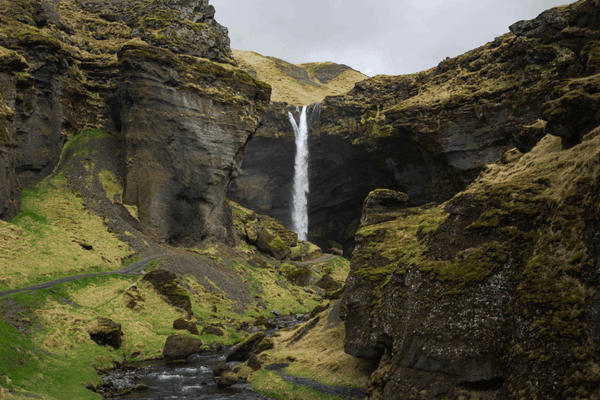
Just behind the Skógar Museum, a 15-minute walk through a peaceful river valley leads to Kvernufoss, which is a 30-metre waterfall that is almost entirely unknown to visitors who stop at Skógafoss just a few hundred metres away. Kvernufoss drops into a narrow, moss-lined gorge with wooden walkways leading behind the cascade, offering a similar behind-the-falls experience to Seljalandsfoss but in near-complete solitude.
For travellers who want to walk behind a waterfall without the crowds of the more famous sites, Kvernufoss is the most reliable option in Iceland. It is free to visit and requires no special equipment beyond sturdy walking shoes.
Credit: Adrien Milcent
Svartifoss
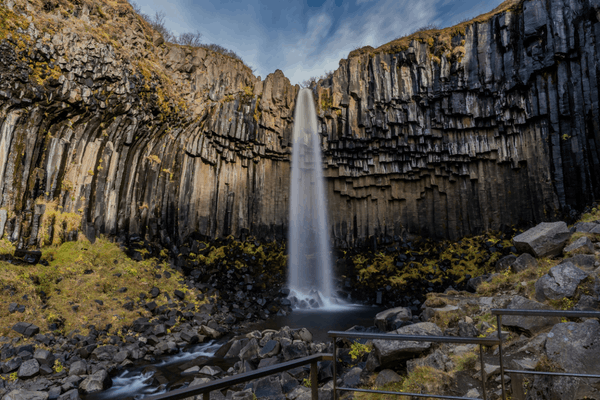
Deep inside Skaftafell within Vatnajökull National Park, Svartifoss earns its place among the most distinctive waterfalls in Iceland not through size or power but through its setting. A 20-metre cascade falls from a natural amphitheatre of dark, hexagonal basalt columns – perfectly geometric formations created by ancient lava flows cooling slowly over thousands of years. The effect is extraordinary: the waterfall appears to be framed by the pipes of a vast organ, the dark geometry of the columns contrasting sharply with the white water and the bright mosses clinging to the surrounding rock.
The columns of Svartifoss inspired some of Iceland’s most celebrated architecture. The state architect Guðjón Samúelsson drew directly from them when designing Hallgrímskirkja, Reykjavik’s iconic church, and the ceiling of the National Theatre. The visual echo between the falls and the church tower, both built on the rhythm of stacked hexagonal forms, is one of Iceland’s most remarkable cultural connections.
Reaching Svartifoss requires a 1.5-kilometre uphill hike from the Skaftafell Visitor Centre, taking approximately 90 minutes return with stops. The trail is well-maintained and suitable for most fitness levels, passing several smaller falls along the way. In winter, conditions can make the trail icy and require crampons. The national park charges a parking fee, but the hike itself is free.
Credit: Marc Donaire Linde
The Golden Circle
Gullfoss (the Golden Falls)
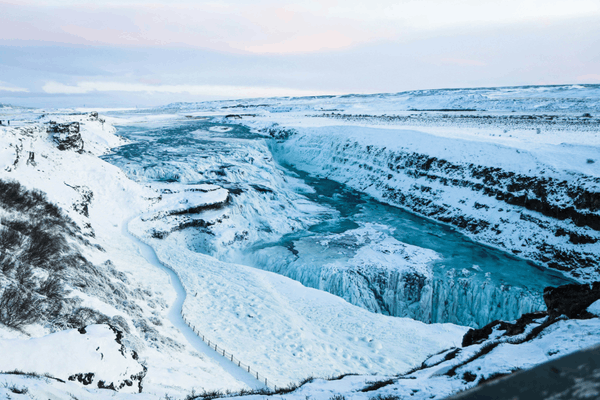
Gullfoss is the anchor of the Golden Circle (Iceland’s most famous tourist route) and one of the most powerful waterfalls in Europe. The Hvítá River, fed by Langjökull glacier, drops in two stages into a canyon 70 metres deep: an 11-metre upper tier followed by a 21-metre lower plunge that disappears into the gorge in a perpetual thundercloud of spray and sound. On sunny days, the mist reliably produces rainbows over the canyon. In winter, ice formations build around the edges of the falls while the central torrent continues uninterrupted, creating one of the most dramatic natural spectacles in Iceland.
The name translates as “Golden Falls,” a reference to the golden-brown hue the water takes on when sunlight hits the glacial sediments carried down from Langjökull. Two viewpoints = an upper platform and a lower trail that brings you close enough to feel the spray, give very different perspectives on the same cascade, and both are worth the short walk.
Gullfoss carries a conservation story alongside its natural one. In the early 20th century, foreign investors attempted to harness the waterfall for a hydroelectric plant. A local woman, Sigríður Tómasdóttir, daughter of the farmer who owned the land, is said to have threatened to throw herself into the falls if the project proceeded. It was eventually abandoned on contractual grounds, and Gullfoss was declared a nature reserve in 1979. Sigríður is commemorated by a plaque near the upper viewing platform.
Gullfoss is accessible year-round, though certain paths near the falls may be closed during icy conditions. A visitor centre and café are located at the upper parking area.
Credit: Michele Orallo
Öxará at Þingvellir
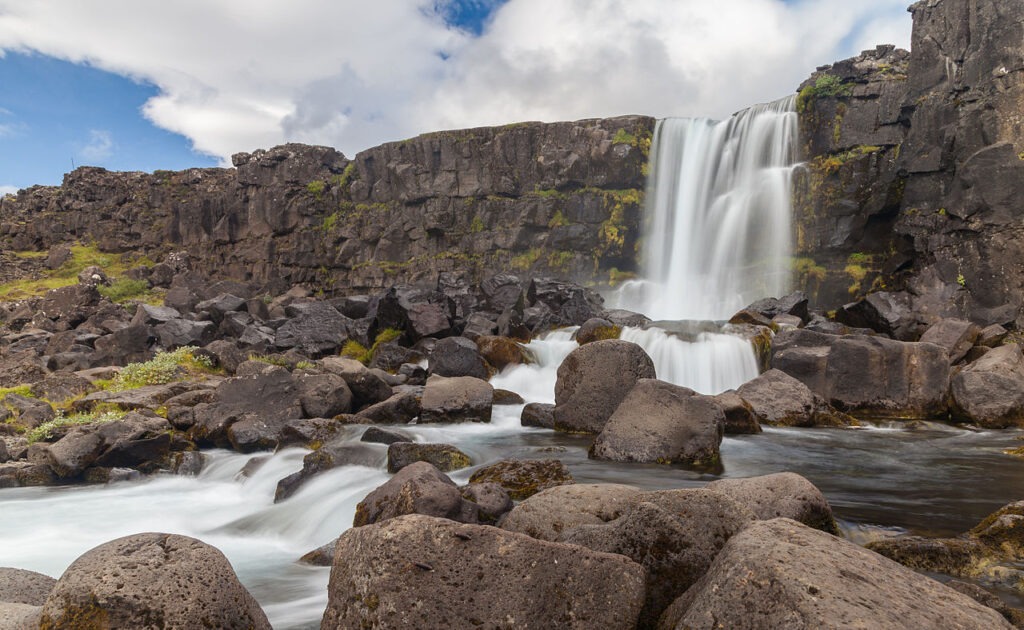
Within Þingvellir National Park, the Öxará River passes through the site of Iceland’s ancient parliament before spilling over a small but historically charged waterfall. Öxarárfoss is modest in scale compared to Iceland’s great cascades, but it sits at the intersection of two of Iceland’s most profound narratives: the geological – Þingvellir lies directly on the Mid-Atlantic Ridge, where the North American and Eurasian tectonic plates are pulling apart, and the political, as the Alþingi met here from 930 AD until 1798.
The falls are easily reached from the main Þingvellir car park on a short walk. They are best understood as part of the wider landscape rather than as a destination in themselves, but for visitors exploring the Golden Circle, the combination of geological drama and historical depth makes Þingvellir one of the most compelling stops in Iceland.
Credit: NAT
North Iceland
Goðafoss
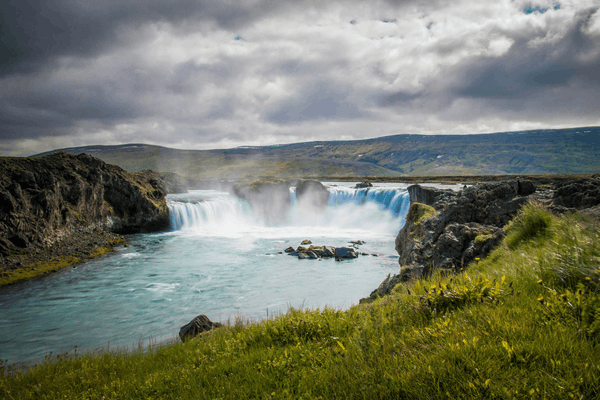
Goðafoss stands apart from all other waterfalls in Iceland for the weight of the story attached to it. According to Icelandic sagas, in the year 1000 AD, the lawspeaker Þorgeir Ljósvetningagoði was tasked with resolving Iceland’s religious crisis. It was a dispute between those who wished to retain Norse paganism and those who favoured Christianity. After deliberating for a day and a night beneath a fur covering at Þingvellir, he announced that Iceland would officially adopt Christianity. On his way home, he stopped at this waterfall and threw his statues of the Norse gods into the cascade. It was an act that gave the falls their name: Goðafoss, the Waterfall of the Gods.
The waterfall itself is not the largest in Iceland, but it is among the most beautiful. The Skjálfandafljót River drops between 9 and 17 metres over a wide, horseshoe-shaped edge into a pool surrounded by low-lying lava fields, the water taking on a striking blue-green colour that photographs rarely capture fully. Viewing paths on both the east and west banks allow a complete circuit of the falls in roughly 20 to 30 minutes.
Goðafoss is located on the Ring Road, approximately 45 minutes from Akureyri, making it one of the most accessible waterfalls in the north. A parking area, toilets, and a small café are available on the east bank. It is free to visit.
Credit: Richard Dorran
Dettifoss
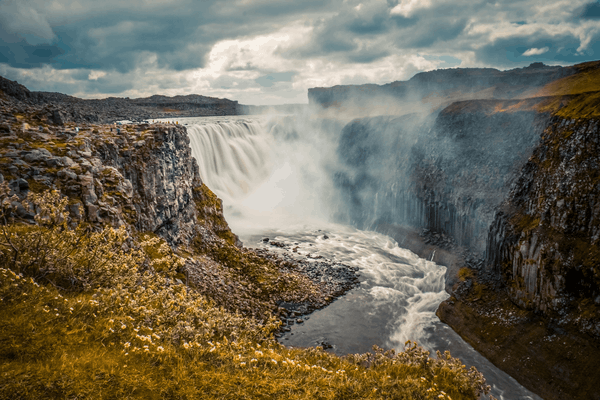
Dettifoss is not the tallest waterfall in Iceland, nor even the most visually intricate, but it is the most powerful waterfall in Europe, and standing before it makes that fact entirely clear. The Jökulsá á Fjöllum River, fed by Vatnajökull (the largest glacier in Europe), drops 44 metres over a width of 100 metres, with an average water flow of 193 cubic metres per second. The sound can be heard from kilometres away. The spray generates a permanent cloud above the gorge. The force of the water is so great that the ground trembles underfoot when you approach the viewing platform.
Where most waterfalls in Iceland have this quality of beauty that invites photography and contemplation, Dettifoss operates in a different register entirely. It is raw, volcanic, and overwhelming. The water is grey-brown with glacial sediment, the canyon walls are dark basalt, and the scale of the whole spectacle sits outside the normal vocabulary of landscape. Ridley Scott chose Dettifoss as the opening location for the film Prometheus, and the choice makes complete sense: the falls look genuinely alien in a way that most natural wonders do not.
Two access roads lead to Dettifoss: from the west (Route 862) and from the east (Route 864). The western approach is paved and provides the most dramatic close-range viewing. The eastern bank is accessible in summer and offers a different perspective across the full width of the falls. From the western viewing platform, a short trail north leads to Selfoss, which is a wider, shallower waterfall on the same river that offers a striking contrast to Dettifoss in character and atmosphere.
Dettifoss is within Vatnajökull National Park in northeast Iceland, approximately 30 minutes from the town of Ásbyrgi and around two and a half hours from Akureyri.
Credit: Richard Dorran
Aldeyjarfoss
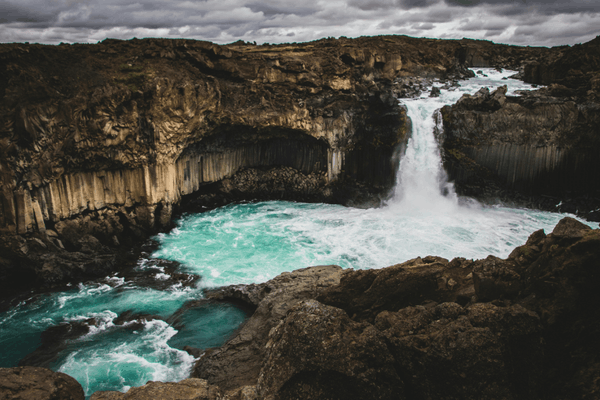
Deep in Iceland’s northern highlands, Aldeyjarfoss is one of those waterfalls in Iceland that rewards the effort of finding it disproportionately. The Skjálfandafljót River – the same river that feeds Goðafoss downstream – drops 20 metres into a turbulent pool enclosed by some of the most dramatic basalt column formations in the country. The columns here have been fractured and tilted by geological activity, creating a landscape of broken black geometry that looks more like a set from a science fiction film than a natural environment.
Access requires driving on the Sprengisandur highland road (Route F26), which is only open in summer and requires a 4WD vehicle. The effort and the planning required mean that Aldeyjarfoss sees far fewer visitors than its natural grandeur deserves, which makes the experience of arriving there quietly exceptional.
Credit: Adam Grabek
The Westfjords
Dynjandi
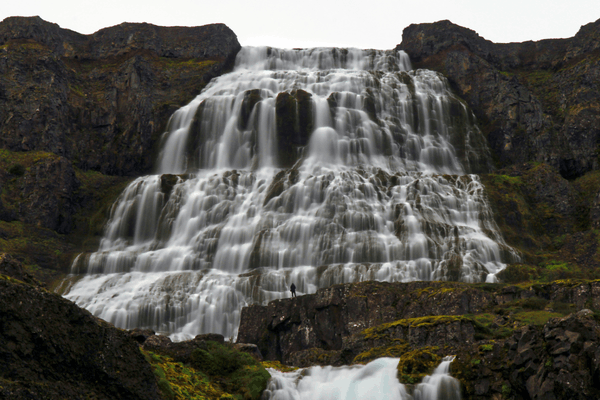
Iceland’s waterfalls operate in different registers. Some are overwhelmed with power, others enthralled with architectural peculiarity or hidden depth. Dynjandi, which translates as “thunderous”, does something rarer and more difficult: it achieves genuine majesty. The waterfall fans out from a width of 30 metres at the top to 60 metres at the base over a total drop of 100 metres, cascading down the mountainside above Arnarfjörður fjord in the shape of an enormous bridal veil. From a distance, approaching along the fjord road, it looks as if a section of the mountain itself has been replaced by water.
Below the main cascade, six further waterfalls tumble down the slope in succession, connected by a marked walking trail with informational signs explaining the geological and cultural history of the area. Ruins of an old turf farm, Bæjarhóll, lie near the base of the falls. Dynjandi and its surrounding waterfalls were declared a protected natural monument in 1981.
The Westfjords are Iceland’s most remote and least visited region, and Dynjandi is inaccessible in winter when mountain roads close due to deep snow and avalanche risk. In summer, the final 1.5 kilometres of road from the main route to the parking area is unsealed gravel, passable in a 2WD vehicle. The trail to the top of the main falls is steep but short (only around 15 minutes of ascent), with the smaller waterfalls providing natural resting points on the way up. Parking costs a small fee, and the hike itself is free.
For those willing to make the journey, Dynjandi is among the most profoundly beautiful waterfalls in Iceland, and one of the most remarkable natural experiences the country offers.
Credit: Patrick Hendry
West Iceland
Hraunfossar and Barnafoss
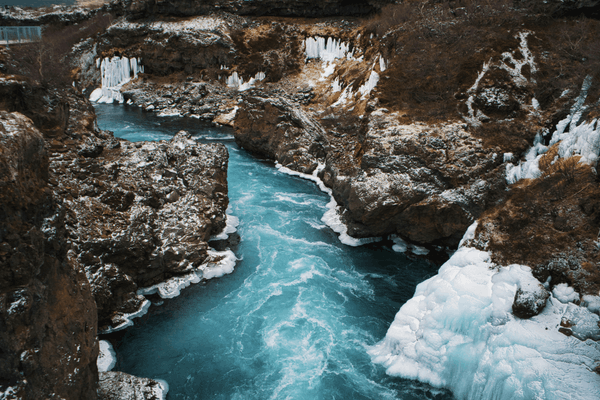
In the Borgarfjörður region of western Iceland, two waterfalls sit a few minutes’ walk apart and offer as striking a contrast as you will find anywhere in the country. Hraunfossar (or “Lava Falls”) is not a single cascade but a series of rivulets seeping out of the Hallmundarhraun lava field along a 900-metre stretch of the Hvítá riverbank. The water appears to emerge from the lava itself, the effect so gradual and diffuse that the whole bank seems to be gently bleeding into the river below. The source is a cold spring originating from Langjökull glacier, filtered through the porous lava rock over decades before reaching the surface. The result is water of extraordinary clarity and an aquamarine blue-green colour that is unlike almost anything else in Iceland.
A short path connects Hraunfossar to Barnafoss (or “Children’s Falls”), where the Hvítá River compresses into a narrow, churning channel through a series of rock formations. The contrast is absolute: where Hraunfossar is gentle and transparent, Barnafoss is loud, violent, and white with turbulence. The name comes from a folk legend in which two children fell into the river while crossing a natural stone arch; according to the story, the arch was destroyed by their mother so that no one else would suffer the same fate.
Both waterfalls are free to visit, with a parking area and toilets nearby. They are accessible year-round, and the combination of the two makes a short but deeply rewarding stop on any journey through western Iceland.
Credit: Nadine Bliedung
East Iceland
Hengifoss and Litlanesfoss
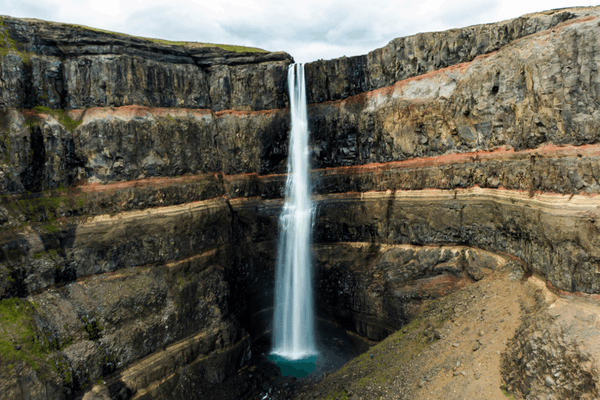
The third-highest waterfall in Iceland, Hengifoss drops 128 metres into a canyon whose walls are striped with layers of red clay and black basalt – sedimentary layers laid down over millions of years of geological activity. The visual effect is extraordinary: the red and black horizontal bands create a naturally formed colour composition that frames the narrow white ribbon of the falls in a way that looks almost deliberately artistic.
The hike to Hengifoss is challenging, taking approximately 45 minutes to an hour each way along a trail that gains significant elevation. Along the route, the smaller Litlanesfoss provides an ideal resting point. It’s a 30-metre cascade framed by perfect hexagonal basalt columns, beautiful in its own right and an excellent preview of what Svartifoss in the southeast offers in a different geological context. Hengifoss is located near the town of Egilsstaðir in eastern Iceland, accessible via a marked trail from the Lagarfljót lakeshore parking area.
Credit: Mattia Avanzi
Practical Notes for Visiting Waterfalls in Iceland
Waterproof clothing is essential. Almost every waterfall in Iceland generates significant spray, and several of the most popular, including Seljalandsfoss, Skógafoss, and Dettifoss, will soak unprotected visitors within minutes. Quality waterproofs for both upper and lower body make the difference between a comfortable and an uncomfortable visit.
Waterfall access varies significantly by season. The major South Coast waterfalls and Gullfoss are accessible year-round. Highland waterfalls like Aldeyjarfoss require 4WD vehicles and are only reachable between roughly June and September. The Westfjords, including Dynjandi, are best visited from May to October. The path behind Seljalandsfoss is typically closed in icy winter conditions. Always check Safetravel Iceland and the road.is for current road and trail conditions before departing.
Stay on marked paths. The terrain around Iceland’s waterfalls is often wet, steep, and uneven. Straying from marked trails near the edge of waterfalls or cliff faces has resulted in fatal accidents. Follow signage, respect barriers, and never approach the edge of a waterfall from above.
Most waterfalls in Iceland are free to visit. Entrance fees do not apply at most sites; parking fees apply at some of the busiest locations, including Seljalandsfoss (approximately 800 ISK) and the Skaftafell area for Svartifoss. The parking fees are modest relative to the experience.
Winter transforms the waterfalls. Many of Iceland’s most dramatic waterfall photographs are taken in winter, when ice formations build along the edges of cascades, frost crystals coat the surrounding rock, and the low, slanting Arctic light turns the scene blue and gold. The experience requires preparation: warm layers, crampons for icy paths, and a willingness to commit to conditions that change rapidly, but winter visitors to Iceland’s waterfalls often find they have them almost to themselves.
Conclusion
The waterfalls in Iceland are not merely natural attractions. They are the country’s most immediate and persistent expression of its geological character. Each one tells a different story of how the island was made and continues to be remade by the forces that define it: volcanic heat, glacial melt, tectonic movement, and the raw physical energy of water finding its way downhill over a landscape that offers no shortage of dramatic edges to fall from.
Whether you follow the South Coast from Seljalandsfoss to Svartifoss, drive the Golden Circle to Gullfoss, journey north to the primal force of Dettifoss, or make the effort to reach Dynjandi in the remote Westfjords, Iceland’s waterfalls will reward you with experiences that no photograph fully prepares you for.
To experience Iceland’s waterfalls and the extraordinary landscapes surrounding them as part of a deeper, more considered journey, explore our bespoke tours, designed to take you further than a standard itinerary ever could.
FAQ
What are the most famous waterfalls in Iceland?
Some of the most famous waterfalls include Gullfoss, Seljalandsfoss, Skógafoss, and Dettifoss. Each is unique – some you can walk behind, while others are known for their massive power.
Where are the three waterfalls in Iceland?
A popular trio on the south coast includes Seljalandsfoss, Skógafoss, and Kvernufoss. They are all located within a short drive of each other, making them easy to visit in one day.
What is Iceland’s biggest waterfall?
The most powerful waterfall in Europe is Dettifoss, located in northeast Iceland. While not the tallest, it’s famous for its immense water flow and dramatic, rugged surroundings.
How many waterfalls are in Iceland?
Iceland has thousands of waterfalls, thanks to its glaciers, rivers, and frequent rainfall. Many are unnamed and scattered across the landscape, making waterfalls one of the country’s most iconic natural features.